Author: brfcjordan95

Can Borussia Dortmund Ever Reach Their Previous Heights Again?

The 12th May 2012. Borussia Dortmund are a club in a state of ecstasy. Having retained their Bundesliga title they have humiliated rivals Bayern Munich with a 5-2 trouncing in the DFB Pokal to secure the double for the first time in the clubs history.  This was the moment that Dortmund cemented themselves as the benchmark team in German football, and it would also be the beginning of the end of their reign.

In the four years since that magic moment a lot has changed for the club. A lot of the key players from that team have since left for pastures new, tempted by big money offers from bigger clubs. The charismatic manager Jurgen Klopp has also departed, leaving after a testing 2014/15 season, replaced by Thomas Tuchel. He is seen in German football as the man most like Klopp, and not simply because he has followed his path from Mainz to Dortmund.

In an attempt to return Dortmund to the days of challenging Bayern Munich for the title this summer the club spent a very uncharacteristic amount of money to try and compete for the title.  After finishing last season in second place they used the money from high profile departures of Mats Hummels, Ilkay Gundogan and Henrikh Mkhitaryan with fellow world class talent.
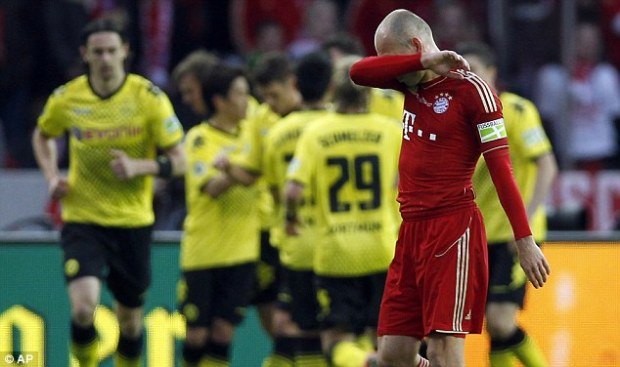
article-0-130f237f000005dc-377_634x376

Bayern Munich winger Arjen Robben is dejection personified as the rival Borussia Dortmund players celebrate yet another goal in their 5-2 humiliation of the German football titans in the 2012 DFB-Pokal final. This result would have wide ranging consequences in the coming years. Photo copyright Associated Press. 

Replacing central defensive rock Hummels was young Barcelona player Marc Bartra, whilst central midfielder Gundogan was replaced with the returning Mario Gotze. The Dortmund youth product left bitterly to main rivals Bayern Munich, but after struggling to cement himself has now returned to his hometown team. Finally Mkhitaryan was replaced with Germany international Andre Schurrle.

It wasn’t just the present that the club was looking at this summer. Looking towards the future they signed several very promising young talents such as forwards Ousmane Dembele and Emre Mor from Rennes and Nordsjaelland respectively. Midfielders Mikel Merino and Sebastian Rode were also signed from Osasuna and Bayern Munich whilst left back Raphael Guerreiro joined from Lorient.

These youngsters along with Bartra join talented players already at the club such as midfielders Christian Pulisic and Julian Weigl along with emerging defenders Erik Durm, Matthias Ginter and Felix Passlack. Whilst this season things have not gone perfectly for the team in the league this season, they currently sit a close fifth but a long way off the top two Bayern Munich and RB Leipzig, in the cup competitions they have shown promise.

hi-res-4200ffedad8a2c7e09f02a6a3617c91a_crop_north

Dortmund’s striker Pierre-Emerick Aubameyang shows the emotions when celebrating a crucial Champions League equaliser against powerhouses Real Madrid at home. He has cemented himself as one of the world’s best strikers and the Madrid club are strongly linked with a £60 million plus bid for him next summer. The match would end 2-2 but Dortmund would have the last laugh, topping the group. Photo copyright TF Images/Getty Images.

They have made it to the last 16 of the DFB-Pokal cup and will be hoping they can continue their good record in the competition.  In the Champions League they have also impressed as they overcame Real Madrid to top their group unbeaten as they now face Benfica in the next round.

It’s clear that the club are still in transition right now, with the legacy of the Klopp era looming largely over the club still. This is entirely natural as his reign took the club from mid-table obscurity to German football powerhouses and world football pioneers. With the squad also in transition as the previous generation of unknown players leave for bigger clubs the next generation of talent is coming through into the first team.

With the likes of Marco Reus and Gotze to guide them they have the potential to once again challenge the established order in Germany, much like RB Leipzig have done this season. The squad is getting younger and this can only mean good things for the future, therefore don’t think that because the majority of well known players and manager Klopp have gone,that the Borussia Dortmund era is over. It might simply be regenerating with a new assortment of players and manager at the helm.

By Jordan Wilkins

Thank you for reading and if you have any comments feel free to post them below. Find me on Twitter @brfcjordan95.

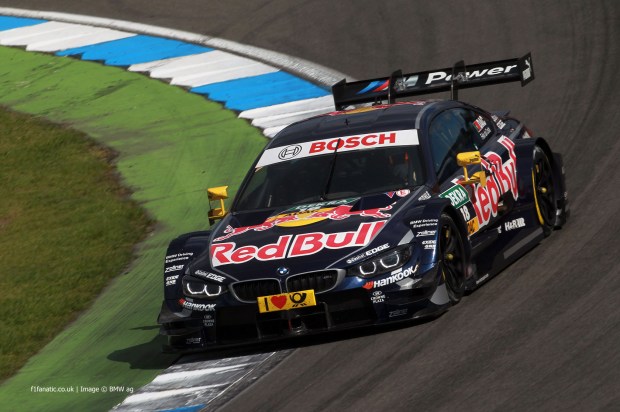
Antonio Felix Da Costa: Proof F1 isn’t Always Right

Recent events have further reminded anyone who has carelessly forgotten that Antonio Felix Da Costa is a seriously quick young racing driver, and is living proof Formula One is not always right. The paddock deemed him not worthy of a seat at the top table of motorsport, he’s now proving them fatally wrong.

In the two years of 2012 and 2013 he set the junior single seater categories alight, with a very close third in the GP3 series being topped by an incredible partial campaign in the Renault World Series. On a grid that arguably bettered that years GP2 series, Da Costa finished an incredible fourth in the series, after missing the opening three rounds.

Replacing fellow Red Bull driver Lewis Williamson, he won four of the twelve races he competed in, he finished only 23 points behind eventual champion Robin Frijns. With a full campaign he surely would have won the championship at a canter. Completing a year unlike almost any other junior categories racing driver, Da Costa then went and won the highly prestigious Macau Grand Prix, a race graced with a winners list that reads like a who’s who of the F1 grid.

F1 Young Driver Tests - Abu Dhabi

Antonio Felix Da Costa in action for the dominant Red Bull team at the end of year young driver test in Abu Dhabi, sadly this would prove a fleeting outing just as the Portuguese driver was on the cusp of a full time F1 seat. Photo copyright Red Bull Racing/Getty Images. 

Alas, after being tipped by Red Bull for promotion to their junior Scuderia Toro Rosso F1 team for 2014, the wheels fell off in 2013. Much was expected of Da Costa but he underwhelmed as he was over matched by Kevin Magnussen and rookie Stoffel Vandoorne. Third in the standings and three wins were not enough to save him, with GP3 champion Kvyat being promoted in place of him, an offer to join BMW in the DTM his best option for 2014.

From this point onwards F1 began to leave him behind, focused on hyping the next wave of young drivers rising the ranks. Da Costa has made the transition to becoming a fully paid professional racing driver, but for some they would have foresaw him F1 this year, not the DTM.

The highly competitive German Touring Car Championship is a very tough series to master, therefore it should not be shocking Da Costa has struggled to adapt to the series and his BMW M4. He shows flashes of potential but has yet to string it together for an entire year, with one win in three years of the series and a best final finishing place of 11th in 2015.

dtm-bmw-daco-hock-2014-2

Da Costa accepted a factory BMW drive in the highly competitive German DTM touring car series, something he struggled to adjust too so far. Flashes of potential show he’s still the same driver who should have found a place in F1. Here he is in action in 2014. Photo copyright BMW AG.

Rising through the ranks it was clear Da Costa was a special driver. A karting series world championship runner up in 2006 first brought him to the attention of the motorsport world, before a move into cars for the 2008 season. Stepping right into the competitive Formula Renault categories, he focused on the Northern European Cup whilst team mate Valtteri Bottas fought it out for the Eurocup.

Best of the rest behind the more experienced Bottas was no disgrace for Da Costa in his first year, with flashes of good form carrying over into the partial Eurocup campaign for him. 2009 would be the year to go for it and emulate Bottas by claiming both the Eurocup and NEC Formula Renault titles, the two most prestigious of the formula itself.

A close third in the Eurocup was deemed slightly disappointing but not a career breaker, with a disqualification from the Nurburgring round for a technical issue in qualifying reining in a campaign just as he was closing in on the title. A dominant win in the NEC series was a good consolation prize and cemented his reputation as an up and coming young talent.

MOTORSPORT / WSR ARAGON 2009

Before F1 testing and the DTM was Formula Renault, where it all started for Da Costa. Victory in the NEC series and third in the Eurocup cemented his reputation as a rising star of the future. Photo copyright Renault Sport.

F3 was the next rung in the ladder, Da Costa acquitting himself well with the Motopark team. Three reverse grid wins and a solid rest of year put him seventh in the final standings, also claiming the prize for being the highest placed rookie in the series. A switch to the British Carlin team for the unofficial F3 World Cup in Macau also proved fruitful, a sixth place finish a great sign of things to come in the former Portuguese colony.

2011 proved tough as he adjusted to a switch into the GP3 category, with only one win and 13th in the final standings to show for it. A partial campaign in British F3 prepared him well for Macau, but sadly a retirement put paid to any chance of resurrecting his career on the world’s fastest street track.

f3-macau-gp-2016-antonio-felix-da-costa-carlin-dallara-volkswagen

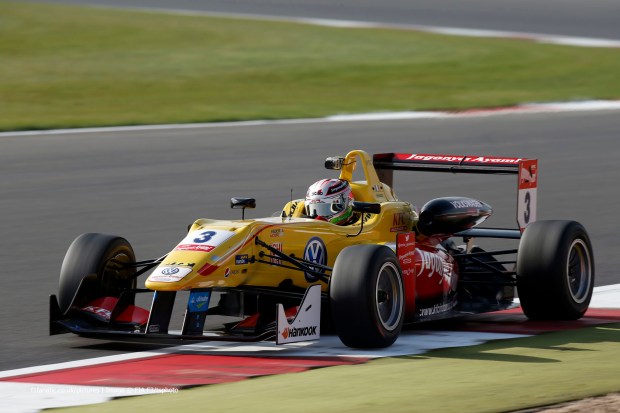
In case needed reminding of his talents in a single seater, Da Costa made a one-off return to F3 for the prestigious Macau Grand Prix. The F3 World Cup proved a commanding and popular victory in the former Portuguese colony.  This was a master class in how to win on the demanding streets of one of the worlds premier junior events, but by now the F1 paddock ad stopped watching. Photo copyright Motorsport.com

Victory on his return to the Macau Grand Prix proved a welcome fillip for him after a difficult year in the DTM, but he was quick to pour cold water on the idea this would re-ignite any F1 ambitions. He seems very comfortable and happy with his roles at BMW and in the emerging Formula E championship.

Whilst at one stage he seemed destined for Formula One, Antonio Felix Da Costa is by no means a failure because he didn’t reach his goals. He can be very proud of his achievements in his career, and whilst some in the F1 paddock may have forgotten about him, victories such as his latest at Macau are reminders to the motorsport world of his talent, and that he is entirely worthy of a place in Formula One.

By Jordan Wilkins

Any thoughts on this article? Feel free to comment below and share your views, find me on Twitter @brfcjordan95 and a huge final thank you for reading!


What we can learn from Robert Enke

Today is seven years on from a major sporting tragedy, and yet outside the confines of it’s home country, barely a word will be spoken or written about it. Yet there is plenty that both fans and professional athletes can learn from it, but sadly precious little lessons seemed to have. Who is Robert Enke you may ask? He was a German goalkeeper who outwardly from a fans perspective seemed to be living a dream life, until he did the unthinkable. He committed suicide at the height of his fame.

With the increasing amounts of money being pumped into professional sports such as football, it reinforces the view professional athletes are somehow not human. With the celebrity lifestyle of a professional athlete it’s assumed by the general public it’s acceptable to say almost anything about these players.

Professional sports are also a hugely macho environment, where any sign of weakness is pounced upon by everyone from team mates to the media. To admit to any symptoms of mental health would be seen as a weakness, something that would give everyone free access to question an athletes ability. In short it would be something that would negatively affect them for the rest of their career.

So how many professional athletes in major sports are currently suffering with symptoms of mental health in silence? Stats from a 2014 FIFPRO study found that one in four professional footballers suffer from depression or anxiety conditions,although the real figure could be much higher as many players may not want to admit to any symptoms for fear of damage to reputation or a perception of weakness amongst team mates. FIFPRO, the international players union, found that 26% of current footballers and 39% of retired footballers suffer from mental health issues.

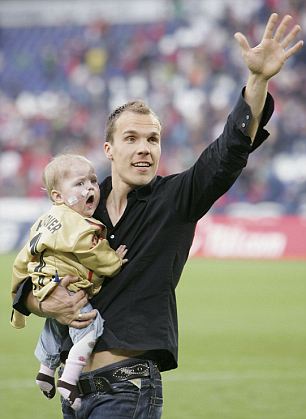
FILE - German National Team Goalkeeper Robert Enke Died

Robert Enke with his daughter Lara, who tragically passed away aged two in 2006. Was this a factor in his second and final bout of depression. Photo copyright Daily Mail.

Within the U.K programs for players suffering with these issues are struggling to match other European nations. For example Germany have implemented wide ranging changes since the passing of Enke, with every club now required to provide psychiatric help for players and a 24 hour anonymous hotline for players to contact in case of emergency. The Robert Enke foundation also works to raise awareness of the condition amongst the general public.

In the high pressure world of football, it’s easy to players to become susceptible to mental health issues. A lot of professionals have been playing for club since a very young age, therefore a lot of their self worth is tied up in football. This becomes an issue with long periods between playing, such as injury or lack of form. For Enke his first bout of depression came in the summer of 2003, after a year spent largely on the sidelines. It was here that feelings of alienation and worthlessness developed, leading to a pronounced period of depression.

It’s likely this problem is larger than we think, with the incessant pressure from the media, coaches, team mates and fans not to make any mistakes on or off the pitch. With so much attention it’s easy to understand how players can develop mental health issues during or after their career.  Without support in place for these players, they are in danger of falling through the cracks of society, in a place for which they may not think they can get out of.

We as a society can learn a lot from the untimely death of Robert Enke,  his is a cautionary tale of how the perceptions of professional footballers are they’re living the dream, but on the inside they could be living with a pain very few people could see. Fame and fortune are no guarantee of a happy lifestyle, just ask the Enke family.

What are your views on this issue? Feel free to comment below with your thoughts. Find me on Twitter @brfcjordan95


Antonio Giovinazzi deserving place in F1

Antonio Giovinazzi. The 22 year old Italian has taken the GP2 series by storm in his rookie season, but he still doesn’t seem to have been placed with the tag of an up and coming talent. Some of the rivals he has previously beaten are being linked with Formula One drives for next year, so why is Giovinazzi not yet being considered for the step up to F1?

The Italian has a stellar junior racing CV, winning at every category he has raced at. From the very beginning Antonio has not followed the traditional path, something that has served him incredibly well to this point. Beginning racing in the Formula Pilota China series in 2012, was a double edged sword for Giovinazzi. He dominated the series with 13 podiums from 18 races, however racing so far away from Europe kept him out of the spotlight.

Giovinazzi moved back to Europe for 2013, but found the running difficult in the ultra competitive FIA European F3 championship. Driving with the Double R team he struggled with no podiums in thirty races, finishing the year 17th overall. In a truncated British F3 campaign he was more successful, with two wins he finished second overall in a small yet high quality field.

giovinazzi-fpc

Giovinazzi in action during his dominant title winning Formula Pilota China campaign in 2012. Photo copyright Formula Pilota China.

After a year learning the circuits and adjusting to the step up in standard, he joined front running team Carlin for 2014. Helping him was support from Jagonya Ayam, the Indonesian KFC franchise. With sizeable long term support Giovinazzi was free to focus on racing. His sophomore campaign was far more successful, with two wins and five further podiums from 33 races. 6th overall was his reward and was seen as one of the top contenders for the following campaign, with the drivers ahead of him all moving up the single seater ladder.

Returning to European F3 for a third year was a risky move for the Italian, with anything other than fighting for the title would seriously halter his career momentum. Staying with Carlin for another year proved fruitful, with six wins propelling him into a title fight with the experienced Swede Felix Rosenqvist. Giovinazzi ultimately finished second, but a win in the one-off F3 Masters at Zandvoort and 4th in the Macau GP showed he was a name to watch.

Not content with having a break during the off-season, he teamed up with fellow Jagonya Ayam backed driver Sean Gelael for two rounds of the Asian Le Mans Series. Winning both rounds kept them both sharp as they prepared for the step up to GP2.

FIA Formula 3 European Championship, round 1, Silverstone (GBR)

Giovinazzi in the opening round of the 2015 FIA European F3 championship at Silverstone. 2015 would be the year he solidified himself as an up and coming driver. Photo copyright FIA F3/TSphoto.

Giovinazzi joined the Prema team for both parties first season in the premier feeder series to Formula One. Whilst both had showed well in F3, expectations were kept low with both being newcomers to the series.  Even with expectations kept low for his rookie season, he will have been disappointed with his start to the season.

With a best finish of 11th from the opening four races, any slim chance of a title challenge seemed to have vanished.So what happened at the next meeting shocked everyone in the paddock. At the all new Baku city circuit in Azerbaijan he proved the class of the field, winning both races whilst others around him struggled to adapt to the challenging street circuit. The two wins propelled him into title contention, as he sat in third position, only eight points behind title leader Artem Markelov. Winning both races of the same meeting had not previously been done since Davide Valsecchi in 2012.

Over the course of the season consistent points scoring kept him in the title chase, as one of the most evenly contested title fights for years played out. With several drivers all vying for the decisive advantage, wins for Giovinazzi in Belgium and Italy were the perfect shot in the arm for his title bid.

sla3340-3689393

Antonio celebrating his double victory in Baku. He was the first driver to do the double since 2012, and the two wins thrust him right into title contention after a poor start to the year. Photo copyright GP2series.com .

His strong finish to the season continued at the penultimate round supporting the Malaysian Grand Prix. A win in the longer feature race was backed up with a fourth in the sprint race, these results proving enough to propel him into the title lead for the first time all year.

With a month to wait until the title deciding final round in Abu Dhabi, the pressure is on for everyone involved. In theory Raffaele Marciello is still in mathematical contention, but being 39 points behind with 48 available, it will be extremely tough for him to come out as champion.

Realistically, the title is going to come down to Giovinazzi and Frenchman Pierre Gasly. Giovinazzi is seven points ahead of the latest Red Bull prodigy, and although its a cliche to say its all to play for, it really is.

Despite Giovinazzi bidding to become the series first rookie champion since Nico Hulkenberg in 2009, he has yet to receive much attention from Formula One. In September it was announced he would be joining Ferrari to conduct simulator work, but this is so far his only link to F1.

wec-fuji-2016-30-extreme-speed-motorsports-ligier-js-p2-nissan-antonio-giovinazzi-sean-gel

Giovinazzi has also dabbled in sports cars over the past year, and could provide another avenue to becoming a professional driver should he be inexplicably overlooked by the F1 paddock. Photo copyright Motorsport.com . 

From the outside it seems a strange move, with such a remarkable debut GP2 campaign and the budget he can bring from his sponsors, the fact he’s not even being linked with any of the remaining available F1 seats seems very strange indeed. Whether the F1 paddock knows something the fans don’t is unknown, but this is a pivotal time in his career.

If the F1 community for some reason discards him, he will still have plenty of options left open to him. He could continue in single seaters and follow the path of 2015 champion Stoffel Vandoorne. He switched the the highly competitive Super Formula series before attempting the move back to F1.

He could similarly change tack and join the burgeoning sports car ranks. The World Endurance Championship and other affiliated series are enjoying a renaissance in the past half decade, with plenty of young drivers moving across from single seaters to the dream of  professional deal with a sports car manufacture.

Whatever happens in Abu Dhabi, Giovinazzi has already proved any remaining doubters wrong this season. His performances have proved he’s a very talented young racing driver who will likely succeed in whatever aspect of racing he competes in over the coming years. Watch out for Antonio Giovinazzi, this is not the last we will hear of him.

What are your thoughts on Antonio Giovinazzi? Please feel free to share your opinion below, I would hugely appreciate it. Thank you for reading. Find me on Twitter @brfcjordan95.
 

End Of An Era With Audi Departing Departing Sportscar Racing

Nobody would have predicted when Audi first went to Le Mans in June 1999 with their two experimental R8R and R8C cars, that they would leave a legacy that would arguably be the most dominant in the sports history. This era has begrudgingly now come to an end with today’s announcement that Audi are to end their sports car effort  at the end of the season. But just how did the Audi brand become synonymous with Le Mans victory?

Expectations were low despite a huge four car entry comprising both the Audi R8R open cockpit car and the R8C coupe. Third and fourth overall in their first running showed their potential, yet very few people would have predicted what came in store next.

A new millennium came and with it was an era of complete Audi dominance in the sport. Returning with their revised R8 model,  a car that would go down in sports car racing as one of those revolutionary cars that change the sport, such as the Ford GT40 and the Porsche 956/962.

12803-web

The Porsche 962 taking its customary place at the front of the field, circa Le Mans 1987. Photo copyright Porsche.

Despite manufactures such as BMW, Mercedes and Nissan all pulling out of the end of 1999, nobody questioned the dominance of their victory. They cruised to a 1-2-3 podium lock out, with a winning margin of 24 four laps over their closest competitors.

The 2001 edition would be a lot tougher victory, with extreme weather conditions and the loss of driver Michele Alboreto only months before the race made it an emotional one for the team. From here it was on wards and upwards, with another victory for the #1 driver line up of Frank Biela, Emmanuele Pirro and Tom Kristensen cementing their place in history as the first driver line up to win the race three years in a row.

The factory team pulled out after 2002, paving the way for sister marque Bentley to win comfortably in 2003. After this small hiccup the R8 returned to the winners circle in 2004 and 2005 in the hands of the privateer Japanese Team Goh and America’s Champion Racing.

img_4754sml2

Tom Kristensen celebrating his seventh win and the final victory for the iconic Audi R8, 2005, the end of an era. Photo copyright AudiWorld.

The R8 will not go down in history as simply a fast car, it was designed to make mechanical issues a lot quicker to fix. It was the first sports car to have this design philosophy and therefore it always had a huge advantage over the rest, because of how little time they would spend in the pit lane.

2006 would herald a new chapter in the Audi story, with the factory returning to Le Mans with an brand new diesel powered R10 TDI. It was the first of its type and would become the first ever diesel powered car to win Le Mans. This was a feat they managed to repeat in both 2007 and 2008, despite opposition from a strong Peugeot manufacture presence.

2009 woulds prove that Audi were human when their new R15 TDI proved uncompetitive at Le Mans thanks to issues with it’s radiators. 2010 and 2011 would provide epic battles with Peugeot as Audi introduced first the R15 Plus and then the R18 TDI, their first closed cockpit car since the initial R8C in 1999.

WEC - 24h Le Mans test day 2012

Audi achieving yet another mile stone, becoming the first overall winner with hybrid power. Photo copyright F1fanatic.co.uk

2012-2014 would bring a further string of victories as they introduced hybrid power into their prototypes. The return of sports car legend Porsche in 2014 provided a mouth watering prospect for everyone involved, but unfortunately it would not be able to live up to high expectations.

Both Audi and Porsche would never both be truly competitive over the three years, with Porsche winning the mini-battle 2-1 in terms of Le Mans wins. Audi this season have proved to be fast but fragile, not a usual characteristic of theirs. Rumours have persisted for most of the season questioning whether they would return in 2017, and today we had the answer.

Whilst I’ve looked back at the success of Audi between 1999 and this year, just looking at their 13 Le Mans 24 Hours victories doesn’t accurately judge their dominance. They had an unbroken podium streak every year they competed at Le Mans, but it wasn’t just in La Sarthe where they ruled the roost. Both the Audi factory programme in the American Le Mans Series and with privateers in the European series, they were to prove dominant for over a decade.

lemans-24-hours-of-le-mans-test-day-2016-8-audi-sport-team-joest-audi-r18-e-tron-quattro-l

Audi’s final Le Mans challenger went out with a whimper. A fortuitous third place doesn’t represent their era in sports car racing, but for now this is the last we will see a factory Audi at the worlds greatest motor race. Photo copyright Motorsport.com 

They have won every significant prototype race on the planet multiple times, and with success as far as the notorious Sebring 12 Hours in Florida right up to their victory in the ALMS Race of Two Worlds at Adelaide in 2000. To try and put into words the level of dominance Audi have had on sports car racing since 1999 is impossible to put into words.

Looking at simply their results doesn’t do them justice. To speak to everyone past and present in the paddock during their period in the sport, would help to tell you one thing. They would all likely say, quite simply, Audi completely changed sports car racing as we know it. Their level of dominance is one that will live in history and will likely prove unmatched for a very long time.

Thank you Audi for an incredible 17 years in the sport, sports car racing owes a lot to their commitment to the category. Quite simply, Le Mans 2017 will be plain weird without them there.

Any thoughts on Audi’s dominance of sportscar racing? Feel free to share your comments below, I would hugely appreciate it. Thank you for reading.


GB cycling receives vital boost with 2019 World Championships

Great Britain and it’s cycling set up desperately needed a boost after recent negative press. Now they seem to have it. Yorkshire won the bid to host the 2019 UCI cycling world championships. This will give them the perfect chance to put behind them allegations surrounding their poster boy Bradley Wiggins.

In recent weeks many experts have questioned Team Sky’s use of TUE (Therapeutic Use Exemption) with star riders such as Wiggins and fellow Tour de France winner Chris Froome. The Sky team are closely linked with GB cycling, itself facing allegations coach Shane Sutton of sexism and bullying. Sutton subsequently resigned, emphasising the turbulent year it has been for British cycling in general, despite huge success in the Olympics and Froome’s victory in the Tour.

Whilst Yorkshire’s dream victory will not be realised for another four long years, the fact the road race world championships will be returning to Britain for the first time since 1982 is a huge step for cycling in this country. The governing body, the UCI, could have easily avoided awarding Britain the championships in the current climate, but they didn’t.

tour-pic

This picture perfectly encapsulates why the 2014 Grand Depart for the Tour de France in Yorkshire was so popular. Imagine the scenes from the 2019  UCI World Championships. Photo copyright Liverpool Echo/James Maloney.

The Tour de France began in Yorkshire in 2014, drawing rave reviews from all involved and huge crowds engaged with the sport for the first time in the case of many. An annual Tour de Yorkshire was subsequently set up by the ASO, organisers of the Tour, again cementing itself as a hugely popular event on the cycling calendar.

For these reasons it seems entirely logical therefore to award it to Yorkshire, despite British cycling taking a battering recently after years of tremendous growth. Outside of allegations made thanks to Russian hackers, this growth is still increasing and the pledge to spend £15 million on hosting the championships is a huge step forward.

Ten years ago spending this amount of money on cycling would never have happened. A lot has changed in the past decade, and who knows how much further the sport will have grown by the time the event takes place in October 2019. I will be one of the no doubt many fans stood amongst the Yorkshire hillside cheering on the riders as the go past.

Why Kevin Magnussen should be in F1

The latest rumour gaining traction in the F1 community is that German Nico Hulkenberg will soon sign for the Renault F1 team. This on the surface seems a logical move as Hulkenberg is a very talented driver with a great reputation in the paddock, but hidden in this information is that they could potentially lose another highly rated driver, Dane Kevin Magnussen.

For anyone watching Formula One this season, the title may prove a struggling one to endorse. Kevin Magnussen has struggled this season with an uncompetitive Renault car in their much publicized return to F1. So why should the Danish driver retain his seat for next season? The answers lie in the details of his career up to this moment.

He has a stellar junior racing CV and has yet to get a fair shake at the highest level. Whilst this may seem strange to say considering he has only ever driven for top teams McLaren and Renault, this is sadly the case. In his very first race at the unfamiliar Albert Park circuit he finished in an eventual second place, the highest scoring debut since Jacques Villeneuve in 1996.

1578617

Jacques Villeneuve in the dominant Williams-Renault on route to second in his debut at the 1996 Australian GP. Magnussen was the first to match his feat 18 years later. Photo copyright Michael Cooper/Getty Images.

Magnussen and McLaren were unable to reach these heights again thanks to a less competitive car and the inevitable rookie mistakes. He did score points in eleven of nineteen races however, and narrowly lost out to world champion team mate Jenson Button 10-9 in the qualifying head to head.

From here the politics of Formula One began to rear their ugly head as not for the first time circumstances beyond his control went against him. After an impressive debut campaign in normal circumstances Magnussen would have been retained alongside Button for 2015. Unfortunately for him, the end of the season would prove anything but normal.

After a disagreements with new Ferrari team principal Marco Mattiacci, Spaniard and double world champion Fernando Alonso was suddenly on the driver market. With a new partnership with Honda starting in 2015, Alonso was quickly announced as having signed with McLaren for 2015.

1418289396_extras_noticia_foton_7_3

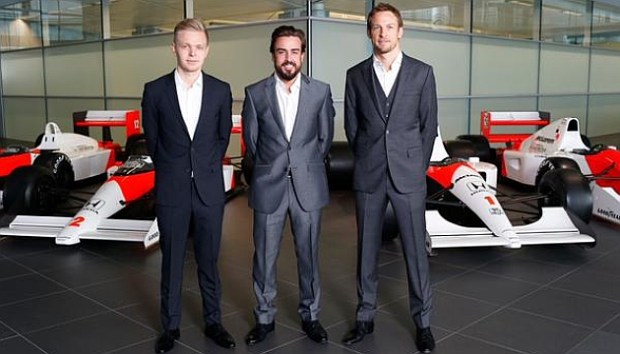
Kevin Magnussen on the left at the presentation of the McLaren-Honda team for 2015. Alongside him is Fernando Alonso, the man who took his seat, and 2014 team mate Jenson Button. Photo copyright McLaren/Marca.

After difficult negotiation the decision was made that the experience of Button would be more beneficial in Honda’s first season back in F1 since 2008. Despite his enormous potential Magnussen was forced to step down from racing and accept a reserve driver role for 2015. Even a potential Indycar drive was vetoed by the team as he was called up to replace an injured Alonso for the opening Australian Grand Prix.

The weekend itself could be used as a metaphor for his F1 career so far. It promised much with a new era beginning with for McLaren, but ultimately delivered little. He qualified last in the unproven car and did not start the race thanks to an engine blow up on the way to the grid.

This would prove the most action Magnussen would see all season, confined to the third driver role for the rest of the year. As the season wore on it became more likely that Magnussen would leave the McLaren team. Despite being part of it’s young driver academy since the early years of his career, he simply found himself at the wrong team at the wrong time.

Motor Racing - Formula One World Championship - Australian Grand Prix - Qualifying Day - Melbourne, Australia

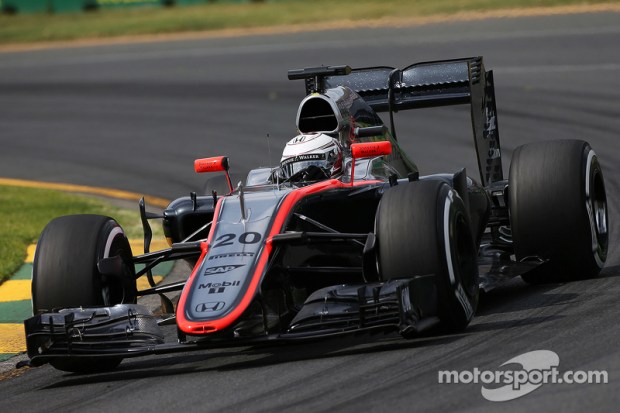
Magnussen in action at the 2015 Australian Grand Prix, replacing the injured Fernando Alonso. It would prove hugely disappointing, as would the rest of the year being on the side-lines. Photo copyright Motorsport.com

With the all star line up of Alonso and Button, it was very hard for the younger drivers to make their way into a full time drive with the team. Despite both reaching the end of their careers, Magnussen still found himself shut out of a race drive for 2016. To further complicate matters, now Magnussen had competition within the team for a race seat.

Belgian Stoffel Vandoorne was a part of the same McLaren driver academy, and a dominant GP2 title campaign in 2015 led many to believe he was ready for the step up to F1. Although he didn’t graduate to F1 full time in 2016, it was clear he would soon be promoted by the team.

Vandoorne appeared to have leap frogged Magnussen into the third driver reserve role, and now the proverbial writing was the on the wall for the Dane. The split was finally announced in early October, with it subsequently being revealed the harsh nature of his dismissal.

vandoornemonaco

Stoffel Vandoorne  on route to one of his many GP2 victories in 2015. He dominated the series and showed he was ready to step up to F1 for 2016. With Magnussen in the fold McLaren faced a choice between the two on who to keep. Vandoorne won out. Photo copyright Sam Bloxham/GP2 Media Services.

The Dane was sent an email notifying him he had dropped from the personal assistant of Ron Dennis on his birthday. The nature of his dismissal seemed to many to be in accordance with the ruthless nature team leader Dennis, who was known for within the paddock. With only several months before the 2016 pre-season testing began, could he find a race seat in time?

A major hindrance for the Dane was his lack of personal backing. In an era where F1 was in a financially unstable time, drivers were increasingly being relied on to bring a personal sponsor package to secure their drive. Despite having a high reputation as a promising young driver, it was clear securing a drive would be very hard for him.

Magnussen was strongly linked to the new Haas F1 team, although many believe he narrowly lost out on the drive to French driver Romain Grosjean. Talks with Manor racing proved fruitless, although salvation would soon be provided from an unlikely source. Reports emerged in late January that the new Renault F1 team were set to replace Pastor Maldonado, after his state sponsorship funding was not forthcoming.

In a matter of a few days, Magnussen was quickly announced as having replaced Maldonado at Renault for the coming season. With a late deal for the season and joining a new team, not a lot was expected of them this year. At the time of writing they have struggled to even match the lowly expectations of them this season.

279501

Kevin Magnussen being presented along with from furthest left, reserve driver Esteban Ocon, team mate Jolyon Palmer and Renault-Nissan CEO Carlos Ghosn in February this year. Photo copyright GP Update/Sutton Images.

The year has been a long one for everyone involved, with Magnussen scoring only two points finishes from seventeen races at the time of writing, with four races remaining. He has managed to get on top of team mate Palmer, beating him 10-7 in qualifying and scoring the teams only points of the year.

Despite having the upper hand this year, it now appears increasingly likely the Renault line up for 2017 will not include Magnussen. Hulkenberg appears to be close to signing with the team, whereas the second seat has been strongly linked with Mercedes junior driver Esteban Ocon. He was on-loan with the team as reserve driver for the first half of the year, before taking on the second seat an Manor Racing.

Outside of Renault there are few remaining seats available, of which plenty of drivers are looking to fill. His most likely option may well be to effectively swap with Ocon at Manor, with other seats either requiring funding or they already have a driver close to signing.

Motor Racing - Formula One World Championship - Australian Grand Prix - Practice Day - Melbourne, Australia

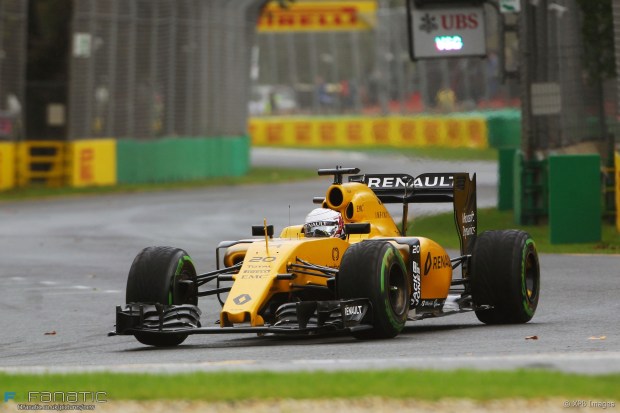
Magnussen  in action for Renault at the opening Australian GP, it has so far proved to be a difficult season for both the Dane and the team.© Copyright: Photo4 / XPB Images

Of course Magnussen does have options outside of F1 such as Indycar or sportscar racing, having contacts in both series from last year. It would be a huge shame however should be forced out of F1, for the problem would of been non-related to his driving. Elements such as politics and funding have almost always prevalent in Formula One, it’s a shame for many traditional fans when it forces a talented young driver out of the sport.

In my own opinion Kevin Magnussen is easily capable of being a grand prix winner given a car somewhat capable of it. Whilst the grand prix conveyor belt is always producing talented young drivers, it seems Magnussen has not been given a fair chance to show his full potential thanks to circumstances outside of his control.

If this is his last season in F1, he will unfortunately join a long list of very talented drivers who have found themselves unable to show their talent thanks to being in the wrong place at the wrong time. Just like last winter, this one will be crucial to Magnussen and the future direction in his career. I for one hope it still involves F1.

Have you any thoughts on this article? Let me know your opinion in the comments section below, I would hugely appreciate it. Find me on Twitter @brfcjordan95.


Have the F.A made the right decision?

Today is the day that the questions will begin in earnest. Should the F.A have removed Sam Allardyce? The 61 year old was a popular appointment as England manager, only 67 days ago, but the recent allegations made against him have proved too much for the F.A to handle. Where does this leave the England national side now?

Allardyce is alleged to have helped potential middle east investors circumvent third party ownership rules. These rules have been in place in England since 2008, and with FIFA since last year. Former UEFA president Michel Platini compared the practice to a form of “slavery”. These were very serious allegations made by the Telegraph in their sting operation, and now it has cost Allardyce his dream job.

Allardyce was also implicated in a 2006 BBC Panorama undercover operation, where he was accused of accepting bribes through his son from agents for signing certain players. This time around it has cost him his dream job, with Allardyce today explaining that “entrapment has won”, as he looks to rebuild his reputation.

3500Sam Allardyce proudly holding the England scarf on the day of his announcement in late July. Little did anyone know his reign as England manager would last only 67 days. Photo copyright FA.

Many will question where this leaves the England team, with Allardyce’s new era over after 67 short days. He only took charge of one game, with the team now in limbo after a hugely disappointing Euro 2016 performance. The F.A now finds itself starting again for the second time in several months, with some early candidates such as Gareth Southgate being put forward by the media.

The debate will rage on across the country in the coming days, were the F.A right to terminate the contract of Allardyce? Both sides of the argument will be well represented, but ultimately the England football team finds itself in a precarious position. After such a disappointing summer, where does it go from here as it aims to put it’s current turmoil behind them. And just who will take on the unenviable task of leading England back to the place where the nation expects them to be? All will become clear in the coming weeks and months. Whatever the outcome, the F.A will have to think long and hard about this decision, as it could have wide reaching consequences in the coming years?

What are your thoughts on the sacking of Sam Allardyce? Too soft or the right decision? Please feel free to comment below and let me know your thoughts. Thanks for reading.

Operation Puerto still hangs over cycling ten years later

June 29th 2006. As the cycling world prepares for the centre piece Tour de France, their biggest race returned to the dark days of it’s recent past. Operation Puerto would prove to be a scandal which brought huge change to the sport, and it’s impact is still being felt today, ten years later.

The world was looking forward to the most open Tour de France since 1998, yet sadly the race would be mired in the same controversy that dogged the notorious 1998 edition of the great race. Just as the words ‘Festina affair’ became as much a part of the cycling lexicon as ‘peloton’, so too would ‘Operation Puerto’.

After years of speculation throughout professional cycling as to widespread doping, the ball would finally be set rolling several years before. Spanish rider Jesus Manzano had detailed to the media the intricate doping practices on his previous Kelme team. This kick started a Spanish police investigation into the allegations made by Manzano.

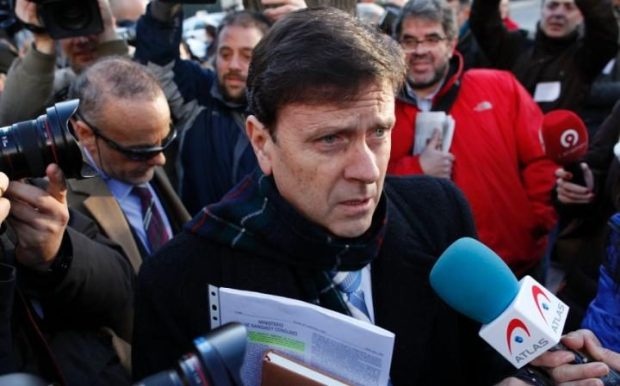
Their investigation made the headlines two years later in May 2006, when police raided the offices of former Kelme team doctor Eufemiano Fuentes, arresting him and several other key members from two of Spain’s professional teams, Liberty-Seguros and Comunidad Valenciana.  What would be found would shock the professional peloton and have wide reaching consequences.

eufemiano_fuentes_arrives_at_a_cou-large_transqvzuuqpflyliwib6ntmjwfsvwez_ven7c6bhu2jjnt8

Eufemiano Fuentes arriving for his Operation Puerto trial. He was originally found guilty of public health laws violations but this was later overturned. Photo copyright Associated Press.

Police found 186 blood bags with code names, along with the equipment needed to freeze and ultimately transfuse the blood. They also found huge quantities of performance enhancing drugs such as EPO,HGH and steroids along with race schedules and information for payments from a large client list of professional athletes. Whilst athletes from other sports were linked to Fuentes, it was cycling that was the most damaged by the scandal.

Almost immediately Liberty Seguros withdrew their sponsorship, leaving the team struggling to find a new sponsor so they could carry on competing past 2006. Very quickly information trickled through to the media concerning the cyclists involved. The big name riders began to fall very quickly, with the Phonak team quickly suspending Santiago Botero, a former world time trial champion and Jose Enrique Gutierrez, who had finished 2nd in the 2006 Giro D’Italia.

The Spanish national road race championship was abandoned after only 500 meters when the riders boycotted the race in protest of the media information detailing the riders who were working with Fuentes. With the sport in the midst of another major doping scandal, the real hammer blow would be delivered only two days before the start of the Tour de France.

The Spanish authorities released their summary into the investigation, formally detailing all 56 professional cyclists known to be linked with Fuentes. The unofficial total was said to be much higher, as it increasingly became clear that Fuentes and his employees were working with seemingly over half of the professional peloton, once again exposing how doping in cycling was pervasive and widespread to the extreme.

The implications were both widespread and immediate. Top riders such as superstar 1997 Tour winner Jan Ullrich and promising climber Oscar Sevilla were immediately suspended by their T-Mobile team. Other riders soon followed. 2006 Giro D’Italia winner Ivan Basso was suspended by Team CSC, whilst GC contender Francisco Mancebo was also dropped by his AG2R team. A large portion of other riders were removed from the race, especially from the former Liberty Seguros team.

ullrich_action1-630x820

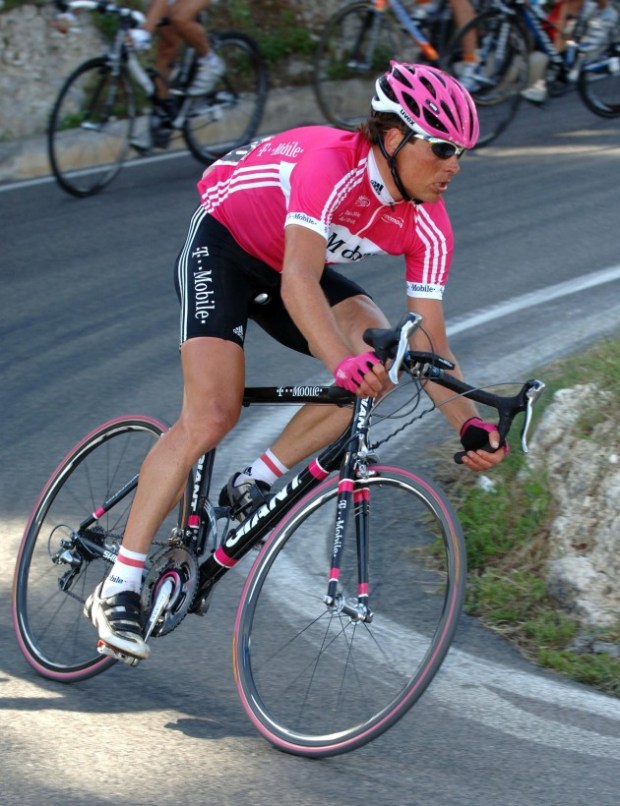
Jan Ullrich riding at the 2006 Giro D’Italia. A few months later his illustrious career was effectively ended by Operation Puerto. Photo sourced from cyclingweekly.co.uk.

The timing could not have been worse for the sport, with their greatest race marred with yet another doping scandal which cast a shadow over the entirety of the 2006 edition. The race was suddenly blown open as none of the top five from the 2005 Tour de France were competing a year later, therefore it was a relatively new cast that took on the mantle of competing to win the race.

The 2006 edition would prove a compelling race with an intense battle for the maillot jaune(yellow jersey) right up until the final stages. Whilst the fans and organisers would have wanted the attention switched to the exciting fight for the lead, yet again the 2006 race would find itself a victim of a doping scandal. American Floyd Landis emerged from the shadow of Lance Armstrong to win the 2006 race, only to be stripped of victory in disgrace a few days later after testing positive for testosterone after his remarkable victory in Stage 17.

The reputation of the sport was once again taking a battering, as Landis became embroiled in a court battle to claim back his victory. After the dust had settled Landis admitted to micro-dosing EPO and taking blood transfusions during the race, but always denied taking testosterone. After the initial denials the riders soon changed their tune. Over the next year the likes of Basso, Jorg Jaksche and Michele Scarponi all admitted to working with with Fuentes, whilst Ullrich was also strongly linked to him.

Fast forward to 2016 and this case is still hanging over professional cycling. Riders linked with Fuentes such as Alberto Contador(cleared),Basso and Scarponi they are still involved with sport as they reach the final stages of their careers. Fuentes himself was originally found guilty, although he has since has his conviction and suspended one year prison sentence overruled.

000_dv96759

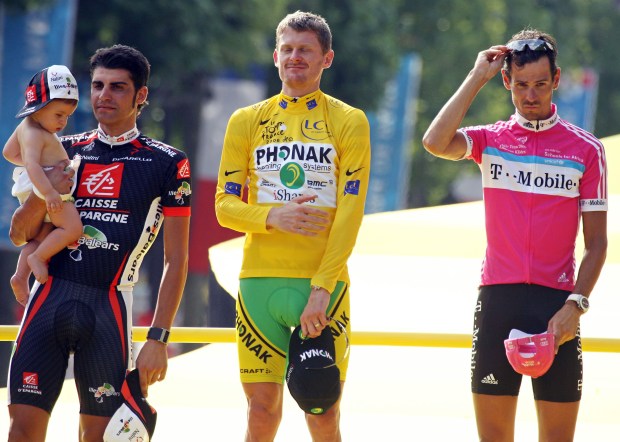
Floyd Landis celebrating on the podium after winning the 2006 Tour de France. A few days later and he would be stripped of his victory in shame after testing positive for testosterone. Photo sourced from velonews.com .

In June of this year Spanish authorities ruled they would hand over the blood bags found in Fuentes possession to anti-doping authorities for evaluation. It’s unclear at this present moment whether these authorities will make public their findings, but with roughly 200 bags to sort through, it’s clear the sport of cycling may well be rocked again if the full influence of Fuentes and his doping practices on the sport are revealed to the public.

In the last ten years the sport of cycling has appeared to have worked very hard to eliminate doping from it’s realm. There have been widespread changes to improve anti-doping testing, and since then there have not been any further major doping scandals within the sport. How much of this can be attributed to Operation Puerto and it’s impact cannot be quantified, but for sure it will have had an effect on enforcing change in the sport.

Cycling is still in the process of recovering from it’s past demons, and for some people they will never again be able to trust the athletes and the sport after years of lies and denials. It’s debateable whether Operation Puerto was the metaphorical straw which broke the camel’s back, but the fact this was the last major scandal before significant change was implemented would seem to support this argument. It was ten years ago, but the sport and the characters involved are still struggling to recover from it’s impact. For American Floyd Landis, it took until this year’s race to return to Paris to watch it in person. It ended the careers of high profiles names in the sport both in terms of riders and team principals. Who knows whether the true impact will only become known in the coming years, if the anti-doping authorities decide to publish their findings. For the sport of cycling, it will undoubtedly open some very old and raw wounds should that happen.

By Jordan Wilkins

Feel free to comment on this article with your thoughts and a huge thank you for reading. If you want to find me I’m on Twitter @brfcjordan95.


Mark Cavendish Proving Doubters Wrong

Britain’s Mark Cavendish has already cemented himself in the history books as the most successful sprinter in professional cycling. After the 2015 Tour de France many however questioned whether his best days were behind him, after being outmatched by German rival Andre Greipel. Countryman Marcel Kittel was also anointed the fastest sprinter in the world, taken the title from Cavendish.

Despite the move to new team Dimension Data and the pairing with old team mates Mark Renshaw and Bernhard Eisel, Cavendish was an outside bet for stage victories behind the likes of Greipel and Kittel. In the space of three days the assumptions about Cavendish from the cycling media and insiders were blown wide open, as the Brit has claimed both the pure sprinters stages in the race, even managing a career first by earning the leaders yellow jersey after winning the opening stage.

Cavendish has once again proved his doubters wrong, something he is surely used to after being questioned at various stages of his professional career. The ‘Manx Missile’ has  already earned a major accolade this year with his day in the hallowed yellow jersey, can he do it again and win a gold medal in the upcoming Rio Olympics next month.

mark-cavendish-tour-de-france-yellow-jersey-maillot-jaune_3494417

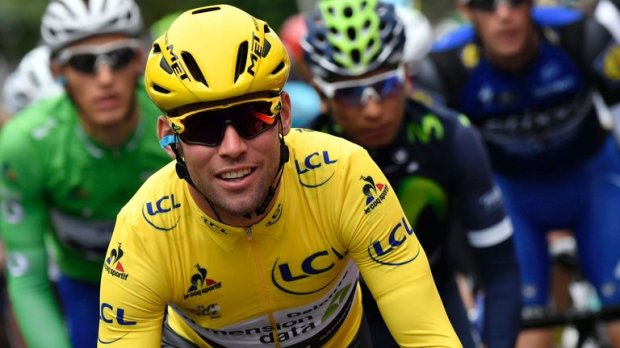
Mark Cavendish enjoying his day in the yellow jersey on stage 2 of this years Tour de France. Photo sourced from SkySports.com.

Much has been made about his track preparations this year, and many questioned whether it would hamper his road racing form going into the Tour. These worries and doubts have been blown away with his two stage wins already, with plenty of opportunities for Cavendish to add to his 2016 Tour tally.

After his success already in this years race Cav is now equal second with French hero and five time Tour winner Bernard Hinault  on 28 stage wins, now only six behind all time leader and cycling’s best ever rider, Eddy Merckx.  He will have plenty of opportunities to claim further victories, although the pressure is off the Isle of Man racer after already exceeding expectations in the opening days.

For fans of Mark Cavendish, the racing has already been thrilling. With a further two and a half weeks where he will have multiple further opportunities for stage victories, can he add to his impressive tally? Only time will tell.

Can Mark Cavendish claim further Tour de France stage victories this year? Let me know in the comments section and thank you for reading. Find me on Twitter @brfcjordan95.