Author: brfcjordan95

Red Bull have dilemma with Toro Rosso seat

Since the shock announcement of Sebastien Vettel last month that he was leaving Red Bull at the end of the season, and the immediate response of Red Bull to announce Daniil Kvyat as his replacement, many have been speculating as to who will take the second Scuderia Toro Rosso seat for next season.

With the headline making rookie Max Verstappen joining for next season, it now seems Red Bull have a straight choice of four drivers to partner him at the Red Bull junior team next season. The ultimate aim of the team has always been to promote young Red Bull talent to the main team and therefore suggests Carlos Sainz Jr will be the favourite to take the seat.

The young Spaniard and son of rallying legend Carlos Sainz has impressed this season to take the prestigious Formula Renault 3.5 series and was a shoe in for a Toro Rosso seat before Verstappen stole his thunder this Summer. Now with Kvyat moving up he has a second chance at a Toro Rosso and it would be difficult to see him moving anywhere higher other than F1. He has impressed in testing with Red Bull and Toro Rosso, and his talent deserves an F1 seat with this being his perfect chance.

Sainz Jr in action earlier this year in the Renualt World Series

The next most likely driver to keep his drive would be the Frenchman Jean Eric Vergne. It looked as if he would be turfed out of F1 after the Verstappen announcement, although he is another to be given a second chance with the Kvyat announcement. Vergne is a quick driver who more than matched ex-team mate Daniel Ricciardo during the races during their two seasons together at Scuderia Toro Rosso.

Vergne is more than deserving of a place in F1, and his main plus for him right now is the experience he can provide to both the team and Verstappen next year in comparison with another rookie like Sainz Jr.

The other two contenders are still being considered, although it does seem from here that both Pierre Gasly and Alex Lynn still have some rungs of the single seater ladder to climb before they reach F1.

Firstly Gasly was hugely impressive in his rookie year in the Renault World series, as the reigning Formula Renault Eurocup champion ended the year well to claim a distant 2nd in the standings behind fellow countrymen Sainz Jr. From here it appears the most likely move for Gasly is to move to GP2 for next year, something he completed a part season in this year for the Caterham team. A deal with the reigning champion DAMS team seems right now the most likely option for Gasly next year, with his talent meaning he will be an immediate title contender next year.

Pierre Gasly racing for Caterham in GP2 this season. Credit goes to GP2 media service for the photo.

The final and most unlikely contender to get a promotion to F1 is the impressive young Brit Alex Lynn. The GP3 champion elect has an impressive junior racing CV including a Macau GP F3 win and numerous titles in British junior racing. He has done everything asked of him this season for Red Bull, although it seems his most likely option right now is to step up to either the Renault World Series or GP2, also at this time it is unclear which series or team he will race with next season.

A time frame for when the announcement will be made has yet to be announced, although for both Red Bull and the driver they choose, the sooner the better as this gives them plenty of preparation time for the coming 2015 F1 season.

At this moment it seems a straight decision between Sainz or Vergne, although Gasly and Lynn could be outside contenders for a role with the team next season. Whichever driver they choose, Red Bull will have picked a very fast young driver, with plenty more queuing up behind him for the moment they falter.

Alonso saga finally coming to a close

Ever since Fernando Alonso publicly made disparaging comments about his Ferrari car after the 2013 Hungarian Grand Prix, speculation has abounded as to his future with the fabled Ferrari team. Whilst Alonso had previously commented on his wish to remain at Ferrari for the rest of his career, and had signed a long term deal tying him to the team until the end of 2016, it appeared increasingly likely he could leave the team as their cars failed to provide with championship opportunities.

At age 33 and coming closer to the end of his career, Alonso was increasingly motivated to add more world titles to his two already from his years at Renault in 2005-2006. Alonso should have won the 2010 world title in his first season with Ferrari, although a strategic error in the final race in Abu Dhabi meant he was stuck behind the Renault of Vitaly Petrov, and was forced to watch Sebastien Vettel steal his first world title from him.

From here 2011 was a lean year as Ferrari struggled and Red Bull dominated, although 2012 saw Alonso wring every last ounce of performance from his once again poor Ferrari car, to take the championship title fight into the final race in Brazil. Despite leading the title fight for a majority of the year, Alonso once again was beaten by Vettel at the final race for the title.

Alonso fighting for the world title at the 2012 Brazilian GP

In 2013 Ferrari once again struggled with a poor car as Red Bull and Sebastien Vettel once again dominated, something Alonso grew increasingly frustrated with. After his response from a reporter asking what he would like for his upcoming birthday in the aftermath of the Hungarian Grand Prix, Alonso sarcastically responded with “someone else’s car.” These were ill timed comments from Alonso as there were persistent rumours at this time that Alonso and his manager were talking to Red Bull about potentially him joining the team to replace his great friend Mark Webber for 2014.

From here Ferrari president Luca Di Montezemolo warned Alonso about his F1 conduct with regards to his comments, with a statement from this time stating “There is a need to close ranks, without giving in to rash outbursts that, while understandable in the immediate aftermath of a bad result, are no use to anyone. That was a reference to the latest comments from Fernando Alonso, which did not go down well with Montezemolo, nor with anyone in the team.All the great champions who have driven for Ferrari have always been asked to put the interests of the team above their own.”

Fernando Alonso in action during the fateful 2013 Hungarian GP

After the prospect of an unlikely Red Bull move was quashed after Daniel Ricciardo was announced as their new driver, it seemed Alonso was stuck with Ferrari until the foreseeable future. This was not entirely a bad thing however, as many tipped Ferrari to benefit most from new 2014 regulation which saw a switch to turbo V6 power. The fact Ferrari would be the only team other than AMG Mercedes producing both their own cars and engines, which suggested they would have an advantage with the design of their 2014 car and engine.

After a mixed testing period, once the season started it quickly became apparent AMG Mercedes would be dominant as the Mercedes engine was clearly the most powerful, with some even suggesting an 60-80bhp advantage over the Ferrari powerplant. It was also apparent the AMG Mercedes and Red Bull chassis were much better than the Ferrari F14T. Alonso once again performed heroics to drag the car onto the podium with a 3rd at the Chinese Grand Prix, it was clear however Alonso would once again miss out on the world title in 2014 as the two AMG Mercedes drivers Lewis Hamilton and Nico Rosberg dominated the season.

Heads began to roll at Ferrari as team principal Stefano Domenicalli resigned after the Bahrain Grand Prix, to be replaced by the CEO of Ferrari North America, Marco Mattiacci. Despite having very little racing experience Di Montezemolo felt his success with Ferrari North America could help provide a fresh impetus to Ferrari. It was clear now that the relationship between Alonso and Di Montezemolo was strained. As the season wore on and Alonso struggled it also became clear Mattiacci felt Alonso could be deemed expendable as his frustrations and lack of commitment to Ferrari increased.

This therefore provided a very unlikely initial rumour which quickly grew much larger. Honda were to join F1 in 2015 with McLaren, and it soon became clear Honda would provide an open chequebook to sign a top line driver. Whilst Sebastien Vettel laughed off the rumours, it soon became clear Alonso was seriously considering the offer. The news that long term Ferrari president Luca Di Montezemolo was to leave the team at the Italian GP did little to persuade Alonso to stay.

Alonso and Di Montezemolo embracing at the 2014 Italian GP

This ongoing saga reached critical mass at the 2014 Japanese GP, where it became apparent in the build up to the weekend that Alonso and Ferrari had reached an agreement to terminate his contract after the 2014 season. In the next few days the bombshell was announced that Sebastien Vettel was to leave Red Bull, with their team principal Christian Horner letting the cat out the bag by announcing he was to join Ferrari. This development left Alonso in a weakened position as it now became obvious his only options for 2015 were to either join McLaren or take a sabbatical.

After brief talk of Alonso potentially taking a year off and desperately trying to get himself into an AMG Mercedes seat for 2016 was shot down by the team, it became clear Alonso would likely sign for McLaren. Whilst the team has struggled in the past two years, and also Alonso’s turbulent season with the team in 2007, it appears fresh impetus from Honda will give Alonso a greater chance to be competitive and add the world titles his craves to his resume. McLaren with Honda will likely by Grand Prix winners within two years, whilst Ferrari are talking of several years of re-building before becoming dominant again.

This is why Alonso was so keen to leave the team, as sticking around for several years of re-building will not leave him enough time to win any more world titles. This optimism is something McLaren can provide with their’s and Honda’s winning pedigree. An official announcement on Alonso’s move to McLaren is likely to come later this month, with the next big decision for the team being whether to retain either experienced Brit and key ally of Honda Jenson Button or the team’s young rookie Kevin Magnussen. Plenty of people in the paddock with be relieved when all the confirmations are revealed, as Alonso looks forward to developing the McLaren-Honda package in 2015.

Photo credits go to :

Alonso 2013 Hungarian GP – http://www.f1fanatic.co.uk/2013/07/28/alonso-faces-investigation-over-drs-breach/

Alonso 2012 Brazilian GP – http://www.motorauthority.com/news/1080651_vettel-picks-up-third-f1-world-champion-after-brazilian-gp

Alonso Di Montezemolo photo – http://www.f1fanatic.co.uk/2014/09/06/hamilton-ends-pole-position-wait-monza/gp-italia-f12014-23/

A beginner’s guide to photography

Photography is something that always look simple enough from the outside, yet to be a competent photographer is something that takes a confident understanding of photographic terms and practices.

The first step to becoming a better photographer is understanding the primary functions of a still camera. Firstly for switching on a still camera most will be very easy to turn on. Simply press any one of the buttons on the back of the camera and this should you to the main menu of the camera.

From here the first things to help you take a great photograph are setting the shutter speed and aperture correctly. The shutter speed is the amount of time that the shutter is left open when taking a photograph. The second key aspect to a good photo is the aperture setting, which coincides with the shutter speed to create your desired photo. I will fully explain how to use both later on in this post.

Some other important features on a still camera are the Auto/Manual focus button. This is important as for beginners it is probably easiest to keep the camera set on auto focus, which means the camera will automatically set the focus to suit the light conditions. Once you get more confident with a camera you will be able to manually focus the camera to perfectly suit the conditions. Below is a full image showing you what most digital still camera layout’s are like.

_RX100_DSC1297b copy

Within the still camera category there are three types, point and shoot, DSLR and 35mm film. All of these have differing uses with firstly the point and shoot being the most simplistic of the three types. It’s primary use is to be easy to use for example for holiday photos. The point and shoot cameras are perfect for people starting out with photography as they have very basic functions yet can still produce a crisp, high quality photo.

The next standard of camera is the DSLR style cameras, which were initially only available to professionals, however recent developments have now meant they have reached the consumer market. These cameras are ideally suited for amateur photographers as the multitude of functions they have can result in a highly professional looking photo if used correctly. The aperture, focus,ISO and shutter speed settings can be adjusted to match certain light conditions for example. These camera settings can help the photographer produce a certain effect if they desire such as a blurred effect or a certain lighting angle.

Finally 35mm are the rarest of the three camera types, mostly because these are older style cameras which have generally been surpassed by modern technology. On the other hand, the 35mm camera were the leading technology at the time, and is still sometimes used as some photographers prefer the shots taken from an older style, less technological camera. Another plus point for 35mm camera are the fact the photographer can manually set the film speed, which can be changed to affect the style and quality of the shot. Generally, whilst 35mm camera have been left behind by modern DSLR and point and shoot cameras, although a keen amateur or professional photographer with good knowledge of 35mm cameras could still produce a high quality photo.

Much like the differing type of cameras, there are several different types of lenses which can be used for differing effects. There are two main types of lenses however, with the first main type being zoom camera lenses. These type of lenses can be adjusted to focus in or out on a particular subject, which makes it a lot easier to take a high quality photo on your chosen subject. Typically zoom lenses are used mostly in small format cameras, and this is simply because of their size and price limit that restricts their use beyond smaller cameras.

The second main type of lens is the “close up” or macro lens. This type of lens is typically used to photograph small subjects in a close up form. The biggest limiting factor however with macro lenses is the fact the depth of field is very narrow, something which is to counter-act means the lens is stopped down to give a greater depth of field. Despite this the macro lens is still a less favorable style of lens to use because of the lower quality of the depth of field in comparison to zoom camera lenses. Both zoom and macro lenses are the most common type of camera lens, there are plenty of other lesser known types which each serve for specific functions, although these types are rarely used for any other purpose.

The time that the shutter is left open is reflected in the shutter speed numbers on the screen. Shutter speed is easy to identify as it is presented as a fraction e.g. 1/125. The higher the numbers such as 1/125 will mean a much crisper and clearer shot compared to a lower shutter speed, such as 1/25, which will produce a more blurry shot.

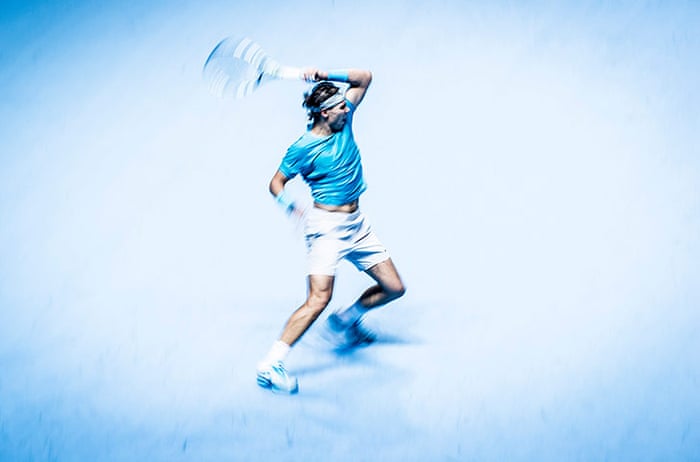
This illustrates how the shutter speed can affect the photo, with this shot taking using a very low shutter speed of 1/30, which has produced this very blurry shot of Rafael Nadal.

The aperture is typically known as the F-stop, with the aperture setting being presented as F followed by a number e.g. F8. The aperture is the amount of light in by the lens therefore in poor light conditions the aperture will be at a high setting e.g. F16, whereas in very bright light conditions the aperture will be set very low e.g. F1.6.

The final aspect to learn as a key function of modern cameras is the film speed, which is the cameras sensitivity to light and is displayed as the ISO setting. This is particularly important when taking photos outside as the wrong ISO settings will mean the photos you take will be of a low quality because of the outside light. Therefore on modern DSLR cameras the ISO settings can be adjusted to suit the light conditions and the overall quality of the photo, with a higher number meaning a higher quality image but in a situation with a lot of light and would not be very good in outside sunny conditions or in rooms with high quality lighting. On the other hand, a very low number will produce a lower quality photo in terms of pixels but will be very good in high light conditions.

Light sources can be used to create a lighting effect within the particular shot, with an example being a slow shutter speed being used to create a blurry effect with the lights. Also studio lighting can be used to suit the subject of the photo, a practice which is commonly used in interviews or photo shoots. Also in outside lighting conditions the natural light can be used to create a desired effect with your photos.

One of the key first steps in learning about taking high quality images is learning the rule of three in photography. This is where you will learn to look at the image viewfinder in a grid format. This therefore means when looking to take a photo your subject is lined up perfectly through the viewfinder in a rule of three symmetry. This is the desired photo effect as it will produce a high quality image. Once you’ve learnt it the viewfinder will become a grid split into 9 squares, of which the desired effect is to have your subject of the photo perfectly framed within the central squares of the viewfinder.Another image composition effect is the golden triangle, which is typically used in photos with diagonal lines. This is composed of the photo being split into three main triangles of equal length which then make up the photo.

When it comes to editing photography, there are plenty of software and websites which can help photographers edit their photos. Some of the most popular editing software is Adobe photoshop and illustrator, both of which are widely used within the industry by professionals and budding amateur photographers alike.

One of the most common photo editing forms is cropping, where you will reduce the outside edges of the photo, and the effect of this is to improve the overall framing of the photo and can vastly improve the quality of the image to focus on a certain subject within the photo. Other popular photo editing techniques are dodging and burning, which decreases and increases the exposure of the photo to make it lighter and darker respectively. This technique is typically used when the photographer is forced to shoot in poor lighting conditions e.g sunlight or darkness, and whilst it cannot rectify extreme examples of either bright or poor lighting, it can help in some cases to improve the quality of the photo.

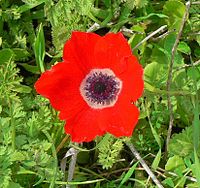
Here is an example of a cropped photo, where the photographer has cropped the outer edges of the photo to focus on the main subject, which is the flower.

The final major photo editing technique is adjusting curves, however this effect is difficult to master and is generally only used by competent amateur and professional photographers. Adjusting the curves is a term for adjusting the tones of a photo. This can have a big effect on the photo, as it can brighten or darken the photo, add contrast and help shift the colours used. Whilst using adjusting curves as an editing tool can seriously alter your photographs, it’s complicated technique means that a degree of competence with the system is needed before being able to use it effectively on your photos.

F1 financial crisis long time coming

Last week’s build up to the United States Grand Prix was dominated by the devastating news within the space of a few days that the lowly Caterham and Marussia teams had both entered administration, and were going to miss at least the next two races if not more. The reaction amongst the F1 paddock is exactly why these two teams went into administration in the first place.

Whilst the top teams and personnel such as Bernie Ecclestone believed it was unfortunate that both went into administration, they also felt there was little they could do to change the spending culture of F1. On the other hand, midfield teams such as Sahara-Force India and Sauber have used both teams as an example of why the revenue streams within F1 need to be changed to make it more sustainable for the lower teams. The only exception at the top calling for change in F1 is FIA president Jean Todt, someone who made known his frequent frustration with failed attempts at a cost cap, something which he feels F1 needs to reduce it’s budgets by roughly 30-40% to make F1 sustainable.

After brief talk of a potential protest from some teams to further highlight the need for fairer revenue streams for the teams, Sahara-Force India deputy team principal Bob Fernley had strong words for the media in the run up to yesterday’s Grand Prix. He was quoted as saying by BBC Sport that ” F1 is at a crossroads. There is clearly an agenda, Two teams have been forced out. How many need to be forced out before they achieve the goal they are looking for? We have missed an opportunity in F1 to be able to get it sustainable, That is passed us and there is no point looking back.”

The strong words show the frustration of the midfield teams as they have been working tirelessly for a long time hoping to achieve some agreement from all the teams for a significant cost reduction in F1. In the last few days however some high ranking F1 personnel have slightly changed their tune and appear now willing to help ensure a cost reduction in F1. F1 supremo Bernie Ecclestone has recently favoured a move to third cars from the top team being loaned out to midfield teams for them to run, yet now appears to show some remorse for the way F1 has gone recently. He is quoted as saying “There is too much money being distributed badly – probably my fault. Like lots of agreements people make, they seemed a good idea at the time. I know what’s wrong, but don’t know how to fix it. ”

This statement from Ecclestone does seem a slight understatement, as it’s believe last year Ferrari earnt $200 million, $90 million of which was fully guaranteed before they even turned a wheel, yet Marussia received only $14 million for completing the whole season as Caterham earned nearly $28 million dollars. For there to remain a steady stream of teams in F1 this clearly needs to be rectified, especially as F1 keeps pushing this green initive starting with vastly more expensive engines for this year.

The uneven revenue structure for the teams currently in F1 only enhances the vicious circle of F1 whereby the best teams get the highest money from FOM, therefore they usually produce a faster car because of their larger budget, which then ensures they further enhance their prize money awarded by FOM. This is only making the performance gap from the top to the midfield teams even bigger, with the likes of Sahara-Force India and Sauber struggling to keep racing competitively this year.

This vicious circle goes back to the late 1990’s and early 2000’s, when manufacters such as Mercedes, Ferrari,BMW, Peugeot, Honda, Renault and Toyota all invested heavily in Formula One. This constant drive for success led to a spending war to which F1 is only just reeling from. Despite most of these manufacters leaving the sport by 2010 the biggest teams such as Ferrari, McLaren,Red Bull and AMG Mercedes have regularly spend over £185 million pounds a year to retain their competitive advantage. With teams like Sauber operating on a budget of £90 million, it’s easy to see why they struggle so much to match the top teams.

This financial model has been in place for several years now, however it’s only this year that it’s rearing it’s ugly head on a large scale. Whilst the demise of the Hispania team after the 2012 season was soon as no more than a backmarker team running out of money, the sudden demise of both Marussia and Caterham has finally showed F1 has a huge financial problem on it’s hands in the next few years. The introduction of highly expensive new turbo engines for this year has ramped out costs, which alongside a constant struggle to find sponsorship in F1 after the financial crisis in 2008, has led to the current situation where half the grid are struggling to pay the bills as the other half refuse to take any significant steps to stop this.

If F1 continues to use it’s current revenue model, we could very soon be seeing a grid of 14-18 cars of which Ferrari,AMG Mercedes, McLaren and Red Bull all supply the rest of the grid with third of even fourth cars. All the while the likes of Sauber, Sahara-Force India and Williams will be consigned to the history books as teams who simply ran out of money. As a passionate fan of F1 this would be a huge shame for the sport if we were simply to have three or four manufacters supplying the whole grid, which somehow doesn’t carry the same appeal of a grid containing 9-10 teams such as Sauber. Still, it would make a lot of money for the teams in extra sponsorship and give them a better portion of the teams prize money so their main priority would be boosted. That’s a crying shame for what is described as a sport, if it’s eventually money which strangles the sport, leaving hundreds of millions of fans and thousands of employees feeling lost.

David Grace avenges earlier defeat in second leg of Austin Healey invitational

The final race of both the day and the 2014 Castle Combe motorsport season was the second part of the Austin Healey Invitational Challenge, with this second 20 minute affair set to be a close race based on the earlier race. The grid was based on the first race results which meant David Smithies lined up on pole, with David Grace alongside him on the front row. The first race seemed to have been one of attrition as both 3rd and 4th placed men from the opening race Bruce Montgomery and Jaap Sinke were sadly missing for this second race, leaving row 2 completely empty.

From the start it was David Grace who made the best getaway to take the lead, going on to open a lead of 1-2 seconds at the end of the opening lap. At the front the first six were quickly dropping the rest of the field, although Grace soon made sure he distanced himself from those behind as he built a 5 second lead by lap 4. Behind them David Smithies was unable to focus on closing down Grace for the lead as he first had to fend off the advances of the Jack Chatham entry, who had risen fast from 6th on the grid to fight for 2nd.

Sadly from here things seemed to spread out amongst the first three as Grace, Smithies and Chatham circulated alone by lap 9. From here it was Chatham who came under increasing pressure from the Martin Hunt/Patrick Blakeney-Edwards entry, with the gap between the top 6 and the rest now a staggering 30 seconds also. The final minutes were run out with no further changes in position as David Grace avenged his earlier defeat to claim the victory, from first race winner David Smithies in 2nd whilst Jack Chatham came home 3rd in the iconic Chatham Cars entry. The Martin Hunt/Patrick Blakeney-Edwards entry was 4th from Karsten Le Blanc in 5th and the Chris Clarkson/Ted Williams entry which completed the top 6.

This was a great race to finish the day and the season off with the Austin Healey providing some good race and excitement for the spectators that stayed until the end. In summary, just like the Autumn Classic every Castle Combe season seems to get better, with great support once again for the local championships and some great series who visited the circuit this year. From here the circuit seems to have some exciting plans although will have to find talented people to fill the long standing shoes of the Fawdington’s, long time circuit employees who are sadly leaving at the end of this year. I for one cannot wait for the 2015 season which should provide some exciting racing once again.

Steve Jones wins battle for 500cc F3 victory at Combe

The penultimate race of the day was an eagerly anticipated one, as it was the first 500cc F3 race to take place at Castle Combe since 1955. In period the category was a regular at Castle Combe as young racers such as Stirling Moss fought to prove themselves, although sadly the category hadn’t returned since it’s heyday in the 1950’s. Luckily the 500 Owners Association put together a well supported grid for this Autumn Classic race, with Steve Jones on pole in his Cooper, with George Shackleton alongside in his similar Cooper.

After a rolling start the 15 minute race got underway with Shackleton assuming the early lead from Jones. After the opening lap the leading pair had an advantage of 1-2 seconds over the rest of the field, suggesting this race would simply be between the leading duo. A mistake from leader Shackleton as he ran wide on the exit of the Esses meant Jones sped through into a lead of 3-4 seconds over the recovering Shackleton on lap 3. Over the next few laps Shackleton did manage to close the gap down to 1.7 seconds by lap 7.

A lap later and Shackleton executed a audacious round the outside move on leader Jones at Camp in what was by far the best move of the entire day’s racing. Sadly it didn’t count for much as Jones used a much better exit from Camp to re-take the lead at Folly on the next lap. From here the first two remained close over the final minutes however there were no further changes in position as Steve Jones claimed a close victory over George Shackleton, with the final podium man Gordon Russell far behind the first two in his unique Mackson racer.

Richard De La Roche was 4th in his Smith racer whilst Darrell Woods and John Turner rounded out the top 6 in their Coopers. This race showed why 500cc F3 was so popular in the 1950’s with again close racing provided almost 60 years later. This definitely showed why the 500cc Owners Association needs to organise a return to Castle Combe next year, something that would hopefully be eagerly accepted by everyone involved. For more information on this great series please visit their website below.

Home

Ellis/Fores too fast for rest in Fiscar 50’s Inter-Marque enduro

Next up on track was the 30 minute Fiscar 50’s Inter-Marque affair, which included mandatory pit stops to ensure an endurance feel to this race. The grid was as large as it was eclectic, with the pole man being the shared Lotus Elite of Robin Ellis and Richard Fores, with the similar Elite of soloist Brian Arculus alongside on the front row. Martyn Corfield was 3rd in this impressive Austin Healey 100/4 whilst earlier Jon Goss Memorial trophy front row man Steve Brooks completed row 2.

At the start it was Brian Arculus who made the best getaway to take the lead as the Ellis/Fores entry bogged down on the line. In the early laps the attention was focused on the recovering Ellis/Fores entry as they passed the fellow shared entry of John Ure and Nick Wigley in their Cooper Bristol T24 for 2nd on the pit straight after 3 laps. A lap later and the Ellis/Fores took the lead as the leader Arculus rocketed into the pit lane at the first possible moment to take his mandatory pit stop. He explained the reasoning was to avoid potential traffic during the stop which could cost him time.

Behind them lap 4 also saw the Mike Thorne/Sarah Bennett- Baggs Austin Healey 100M pass the Ure/Wigley Cooper for 3rd on the Dean straight. With Arculus pitting this promoted the Ure/Wigley Cooper back into 3rd, although this didn’t last long as they were deposed again, this time by the flying Simon Hadfield in his under powered Elva Courier on lap 5. From here it quickly became apparent the Ure/Wigley Cooper was dropping away from the top 3 by lap 7. Back at the front and it was clear that the man on the move was earlier Jon Goss Memorial trophy winner Simon Hadfield in the Elva. He passed the Thorne/Bennett- Baggs Austin Healey for 2nd on lap 8 and claimed the lead a lap later as the Ellis/Fores Lotus pitted, losing time as he was held up by slower cars also pitting at the same time.

Also on this lap the Ure/Wigley recovered from their earlier drop in pace to pass the Thorne/Bennett-Baggs Austin Healey for 3rd, which prompted both the Healey but also the 4th placed Martyn Corfield in his Healey 100/4 to pit a lap later. It was at this middle portion of the race that the majority of the pit stops were being made, making it very hard to track who was where in the jumbled up portion of the race. Lap 11 saw the Ure/Wigley Cooper pit from 2nd, with an entertaining scrap taking place a lap later as the recovering Ellis/Fores Lotus Elite bravely attempted to unlap himself from the leading Hadfield Elva.

With almost three quarters of the race gone the final front runners to pit were Hadfield and 2nd man Steve Brooks on lap 14, as Hadfield handed over to his wife Amanda. This reinstated the Brian Arculus Lotus Elite in the lead, whilst the Elva now piloted by Amanda Hadfield plummeted down the order over the final laps as she failed to match the scorching pace set by her husband Simon.

Back at the front and the Ure/Wigley Cooper was flying as it passed the Arculus Lotus Elite for the lead on lap 17. The battle for the lead intensified on the next lap as the rapidly closing Ellis/Fores Lotus finally caught the lead pair. A 3 way dice for the lead going up Avon Rise was finally decided as the Ellis/Fores Lotus blasted through the middle to take the lead on lap 18. From here the lead three remained close although they didn’t change position again as the flag fell at the end of lap 20. The Robin Ellis/Richard Fores Lotus Elite claimed a narrow victory from the solo Brian Arculus Lotus Elite whilst the John Ure/Nick Wigley Cooper Bristol completed the podium. Martyn Corfield was 4th in his Austin Healey 100/4 whilst Steve Brooks and the Andy Shephard/Ted Shephard AC Ace Bristol completed the top 6 in a thrilling Fiscar 50’s Inter-Marque race.

Wakeham recovers from poor start to claim VSCC Pre-War victory

The Vintage Sports Car Club are always popular at Castle Combe, and they kindly put together a grid for an invitational race after their regular season finished at Snetterton the week before. Combe and the Autumn Classic is obviously popular with the drivers as a high quality grid lined up for their 20 minute curtain closer to their season. David Freeman was on pole in his Aston Martin 2 Litre Speed Model whilst Frederic Wakeham was on the outside of the front row in his Frazer Nash Super Sports. Mark Brett was 3rd in his unique Ballamy-Ford V8 Special whilst Sue Derbyshire completed row 2 in his three wheeler Morgan Super Aero.

At the start it was 3rd man Mark Brett who made a lightning getaway to shoot between the middle of the front row to claim the early lead. Behind them it was all change in the early laps as David Freeman passed Wakeham for 2nd on lap 3, only for Wakeham to re-take the place on the pit straight at the beginning of lap 4. Later on in the lap and Wakeham completed his mission as he claimed the lead from the fast starting Brett. Lap 5 and things got worse for Brett as he was further demoted to 3rd by pole man David Freeman. At this stage Wakeham was attempting to break away from the rest as he opened a 1-2 second lead on the rest.

From lap 6 it was clear Wakeham and Freeman were breaking away from the developing battle for 3rd between Brett and Andrew Mitchell. After several laps of dicing for 3rd it was finally resolved on lap 9 as Mitchell passed Brett. Back at the front Wakeham now had a lead of 1.5 seconds, something he extended to 3.3 seconds by lap 11. From here things remained the same as Frederic Wakeham came home the victor, from David Freeman in 2nd and Andrew Mitchell who completed the podium.

Fast starter Mark Brett came home 4th whilst Sue Derbyshire and Patrick Blakeney-Edwards completed the top 6. This race has plenty of excitement with close battles and spectacular driving in these Pre-War race cars with a remarkable variety of little known manufacters, which is exactly why the VSCC is so popular with the Castle Combe spectators every year they race here. For more information on this great series please visit their website below.
http://www.vscc.co.uk/

Martin Hunt takes Norman Dewes Pre-66 Jaguar Trophy at Combe Autumn Classic

After a brief break in the racing proceedings, for some high speed demonstrations from the likes Julian Bronson in his Scarab Grand Prix car, a Maserati 250F and other classic racing exotica, it was the turn of the Pre-66 Jaguar grid to form up for their 30 minute Norman Dewes Trophy race. On pole was Martin Hunt in his Jaguar E Type, with Mark Russell alongside him in his similar E Type. Row 2 was made up of well known retired sportscar racer and 1988 Le Mans 24 Hours winner Andy Wallace in an older Jaguar C Type, with Graham Bull completing row 2 in another E Type.

From the start pole man Martin Hunt made a good start to take the early lead, as the rest spaced out behind him in the early laps. The gaps between the top three were now evenly spaced with the only drama in the middle portion of the race being Andy Wallace, who appeared to be struggling to keep hold of 3rd from Graham Bull behind him. After a backmarker spun off on the exit of Camp with his car broadside against the tyres on the pit straight the Safety Car was deployed on lap 16 so the recovery trucks could safely recover the car.

After 3 laps the Safety Car peeled in again on lap 18, as Brian Stevens took advantage of this to dive inside Graham Bull for 4th at Camp after the Safety Car came in. Whilst it appeared a dubious move as both cars had yet to pass the start finish line no action was taken by the stewards after. Anyone who was hoping Martin Hunt would now be challenged for the lead were disappointed as second driver in the queue failed to keep up with Hunt on the re-start, allowing him to open a huge lead again as the other front runners were held up behind slow back markers.

A lap later and things took a turn for the worse for Andy Wallace in 3rd as he was forced onto the grass to avoid a spinning car, dropping him from 3rd to 5th with only a few laps left to recover. From here things remained stagnant for the final two laps as Martin Hunt cruised home after 21 laps to claim victory, with Mark Russell and Brian Stevens completing an all E Type podium in 2nd and 3rd respectively. Graham Bull was 4th in his own E Type as Andy Wallace remained 5th in his C Type with Colin McKay completing the top 6.

Whilst the race lacked in wheel to wheel battling slightly, that’s to be expected with the value and age of the machinery on the track, something that still fascinates me to this day. The Safety Car leveled things out although this race has just enough of everything to ensure this was a great race for the plentiful spectators.

Simon Hadfield dominates Combe Aston Martin Jon Goss trophy

Race 3 of the Autumn Classic meeting at Castle Combe was for historic Aston Martin’s, with a short 20 minute race for the Jon Goss Memorial trophy. On pole was rapid historic racing proponent Simon Hadfield in Wolfgang Freiderichs Aston Martin DB3S, with Simon Brooks alongside him on the front row in is DB3S. Row 2 consisted of David Reed in his DB2 with Chris Jolly completing the row in his similar DB2.

From the lights Hadfield rocketed away into an early lead as the rest jostled for position behind him. After the first lap it was clear Hadfield was on a mission as he seamlessly built an opening lap lead of around 5 seconds over the rest. Behind him too, 2nd and 3rd placed drivers David Reed and Chris Jolly were beginning to distance themselves from the rest also. By lap 3 it was clear barring mechanical problems that Hadfield would dominate this race as he was stretch his lead by 5 seconds a lap at the front.

With the lead now at 16 seconds by the end of lap 3, Hadfield kept stretching the lead as the rest of the top six were now evenly spaced also. On the fringes of the top six things almost changed as Steve Brooks almost fell out the top six after spinning on lap 9 at the Esses, although he re-joined still in 6th. It was clearly a tough race for Brooks as the spin showed he was struggling, especially as he had quickly fallen down the order from the 2nd spot on the grid.

In the later stages the race came alive somewhat, as Paul De Havilland, in his invitational Jaguar XK150, passed Chris Jolly for 3rd on the penultimate lap. A lap later, on lap 15 Simon Hadfield completed the final lap to take the chequered flag a staggering 56.482 seconds ahead of David Reed in 2nd after only 20 minutes of racing. Paul De Havilland completed the podium with Chris Jolly coming home 4th. Gordon McCulloch and Steve Brooks completed the top six with 5th and 6th respectively. Whilst this race didn’t have many battle it still provided excitement and intrigue at the skill of Simon Hadfield’s driving, a true display in how to hustle a historic racing car.