After the drama’s and tension of the Monaco GP weekend two weeks ago, the F1 circus was hoping for a much calmer weekend as they arrived at the ever popular Circuit Gilles Villeneuve. This race weekend is always popular with teams, drivers and fans alike and an interesting weekend was predicted. This circuit always provides competitive racing thanks to it’s unique nature with braking being crucial around this high speed stop lap.
The Q1 drama began before the session had even got underway as Sauber sophomore driver Esteban Gutierrez was forced to sit and watch Qualifying as the his car needed a new chassis after a crash in Free Practice 3. This meant only 5 drivers would be eliminated this time around, somewhat easing the pressure . As the cars trickled out slowly it was Williams driver Valteri Bottas who set the first competitive time with a 1.18.270 after 4 minutes.
Unsurprisingly this time didn’t last long at the top as AMG Mercedes driver Nico Rosberg subsequently smashed that time with his own 1.16.690 with 12 minutes left in the session. Canada specialist Lewis Hamilton wasn’t going to let Rosberg get too comfortable atop the times however as he soon chimed in with a 1.16.438. Then with 8 minutes to go he improved to a 1.15.750, a nice statement of intent on his part for qualifying. After this the session calmed down slightly before the intensity increased in the final minutes.
First Lotus-Renault driver Pastor Maldonado pulled off track at Turn 2 with a lack of power, in the process guaranteeing his elimination in Q1. Things did improve his slightly however, as Caterham rookie Marcus Ericsson stuffed the rear end of his car into the outside wall exiting Turn 9 with 16 seconds left. The ensuring red flag would end the session and cement everyone in their Q1 positions.
Sharing the back row are the Sauber of Esteban Gutierrez and the Caterham rookie Marcus Ericsson. Caterham team leader Kamui Kobayashi lines up 20th, with Marussia driver Jules Bianchi 19th. Max Chilton out-qualified team mate Bianchi for the first time in 2014 in 18th alongside the unlucky Lotus-Renault driver Pastor Maldonado in 17th. Since qualifying things have got worse for Caterham however as Kobayashi has been forced to take a gearbox change, demoting him to 21st behind team mate Ericsson.
Q2 began with star Sahara-Force India driver Nico Hulkenberg being the first to set a competitive time with a 1.16.650 in the first few minutes. Both the Williams drivers looked hugely competitive this weekend and they soon flexed their muscles in Q2, with Felipe Massa quickly setting the pace with a 1.15.773 with 11 minutes to go in Q2. The major surprise of Q2 was the fact the two AMG Mercedes drivers were unable to beat Massa’s time, although this can be explained by the fact they didn’t run the softer tyres which Massa did.
The final minutes were frantic as always but the biggest surprise again was that the AMG Mercedes drivers went out for a final run when they appeared safe for Q3. Nevertheless, their softer tyre runs rewarded them with Rosberg first with a 1.15.2 before Hamilton eclipsed him with a 1.15.0 to top the Q2 session. From Q1 and Q2 the advantage AMG Mercedes enjoyed a 0.7s gap to the rest, ensuring Q3 would be another intense battle between the two.
Those who sadly wouldn’t be making Q3 were a disappointed Sahara-Force India driver Nico Hulkenberg in 11th, alongside McLaren rookie Kevin Magnussen in 12th. Sahara-Force India’s disappointed day was completed a Hulkenberg’s team mate Sergio Perez only managed 13th, sharing row 7 with Lotus-Renault driver Romain Grosjean in 14th. The 8th row would be shared with Scuderia Toro Rosso rookie Daniil Kvyat in 15th alongside Sauber driver Adrian Sutil in 16th.
The final Q3 session began slowly with Valterri Bottas the first to venture out after 2 minutes. His first lap time was a 1.15.550 with 7.30 left on the clock. His reign at the top was short however as Nico Rosberg soon eclipsed him with a 1.14.946 lap, which even team mate Hamilton couldn’t match. As the cars settled in the garage’s ready for their final run, Ferrari driver Kimi Raikkonen gambled on setting a quick lap whilst the track was quiet. This gamble didn’t work however as he only managed 8th on his one flying lap.
The final run’s were an anti-climax as a bad lap from Hamilton handed Rosberg pole on a plate, with Rosberg improving by a tenth just to make sure of pole. Reigning world champion Sebastien Vettel produced the lap of the session to steal 3rd from the Williams drivers in an inferior Red Bull car. William sophomore Bottas usurped experienced team mate Massa for 4th and 5th, with Vettel’s Red Bull team mate Daniel Ricciardo disappointed with 6th. Fernando Alonso qualified 7th from an impressive Jean Eric Vergne in the Toro Rosso in 8th. The 5th and final row of the top 10 would be shared by Jenson Button in the McLaren and Raikkonen completing the top 10 for Ferrari.
Qualifying set up the race later on today perfectly in what should be an impressive race long fight between the two AMG Mercedes drivers. Behind them the battle for the final podium spot should be just as interesting between the Red Bull and Williams cars. Also watch out for the two Sahara-Force India cars, as they are always more competitive in race trim with their car notoriously soft on it’s tyres. Watch out for their progress during the race.
After the excitement of the first four flyaway races F1 returned to Europe after a long three week break. The popular European portion of the season begins this weekend with the Spanish GP, a track known to highlight the chassis and aerodynamic proficiency of your car. With all of the teams bringing significant updates everyone went into qualifying hopeful their updates had significantly improved their performance.
Immediately out in Q1 were both Sauber cars, hoping their lightened car would push them further up the grid after a difficult start to their season. The first drama of this session was a brief red flag period early in Q1 as the Lotus-Renault of Pastor Maldonado ran wide on the exit of Turn 3 and lost the wayward car before it glanced the barrier on the inside of the corner, breaking the right front wheel and eliminating Maldonado from the session. After the initial talk that this is a Red Bull track and therefore AMG Mercedes might struggle, this talk all proved unfounded as the Mercedes cars had a comfortable 0.7 second gap to the rest after Q1.
At the end of Q1 there were few surprises as the predicted faces were eliminated with Maldonado in 22nd after failing to set a time, with Kamui Kobayashi qualifying a disappointed 21st for Caterham. His rookie team mate Marcus Ericsson impressed with 20th in the other Caterham with the Marussia of Jules Bianchi in 19th from team mate Max Chilton in 18th. The final man eliminated was a disappointed Adrian Sutil in 17th with his new lightened Sauber showing little signs of improvement so far this weekend.
Q2 began with the Sahara- Force India’s cars coming out quickly before the pacesetters filtered out to set their first times. Nico Rosberg was setting the pace with a 1.26.0 with only a nice 0.6 second gap to the best of the Red Bull’s in 3rd. This session proved intriguing as pre-session session favorite for pole Lewis Hamilton appeared slightly scruffy as team mate Rosberg appeared to have the edge at this point going into the final Q3 session.
Of those eliminated in Q2 it was unsurprising to see both the Force India’s in 11th and 12th with Nico Hulkenberg ahead of Sergio Perez. 13th was okay from rookie Daniil Kvyat as Esteban Gutierrez came home 14th. The final two places were reserved for the cars that failed to set a time with Kevin Magnussen suffering a power unit failure whilst Scuderia Toro Rosso man Jean Eric Vergne had a 10 place grid penalty hanging over him after a FP2 mishap, therefore it appears his lack of running may have been a tactical decision by the team.
The final Q3 session began slowly before Nico Rosberg finally ventured out for his first run with 10 minutes left of the session. He was over halfway through his first timed lap when his run was abruptly halted as the red flags flew for a second time in this qualifying session, as the Red Bull of reigning world champion Sebastian Vettel stopped on the entry of Turn 3 with a suspected gearbox failure. The first race with his new chassis has proved difficult for Vettel with limited practice running and now a 10th place grid spot for tomorrow’s race to compound his problems.
When the session resumed Rosberg again set his first run time before Hamilton slightly eclipsed him going into their final runs. With seconds left on the clock the both started their final laps with Rosberg smashing Hamilton’s previous time before a nervous wait to see what Hamilton managed behind him. Luckily for Hamilton he had just enough in hand to set pole with 0.168 margin of pole from team mate Rosberg.
Row 2 will be filled with the Red Bull of the ever impressive Daniel Ricciardo with Martini Williams sophomore Valterri Bottas impressing again with 4th. Romain Grosjean was the standout of Q3 as he dragged his skittish Lotus-Renault into 5th when team mate Maldonado lost control in Q1 and will start 21st, whilst Kimi Raikkonen must be thrilled to out qualify team mate Fernando Alonso in 6th for Ferrari.
Alonso wasn’t far behind in 7th from Jenson Button in 8th for McLaren. The final row of the top 10 will be filled by Felipe Massa in 9th for Williams from the Red Bull of Sebastian Vettel who obviously didn’t set a time. The grid is set in what promises to be an exciting Spanish GP race tomorrow.
Throughout the world Ayrton Senna is known for being one of the greatest Formula One drivers of his generation, however in his native Brazil he is known more prominently as a sporting hero who made great strides in combating social problems such as poverty and illiteracy in Brazil. He primarily helped children and was someone who provided rare joy to a country experiencing many social, political and economic problems during his career.
Ayrton Senna Da Silva was born on March 21st 1960 in Pro-Matre Maternity Hospital of Santana, a neighbourhood of São Paulo to his parents Neide Senna Da Silva and Milton. He was born the middle child of the family with an older sister Vivane and a younger brother Leonardo, with the family giving Senna the nickname ‘Beco’. From an early age Senna excelled at physical sports and developed an interest in motor racing from the age of four years old. At the age of seven he first learned to drive the family car on their extensive land showing an early appetite for cars. Throughout his school life Ayrton was dedicated and recognised the importance of education, however his sporting ambitions always came first. Examples of this are the fact that once he started Go-Kart racing he would pay extra attention in class so that he would not have any schoolwork to do at home therefore giving him maximum time for his Go-Karting.
Also prevalent from an early age was his compassion and sympathy with those less fortunate than him, as the Senna family was well off financially. Even at a young age Senna was aware of those less fortunate with an example told often is of a poorer child in his neighbourhood being told by Senna to visit his house later on that day. The child remained sceptical of his intentions but when he eventually visited the Senna house Ayrton gave him his new expensive tennis racquet to help this poorer child out. His early passion for karting soon meant he was given his first homemade kart of which he spent almost all his spare time practising. Fairly soon after being given his first kart he was beginning to practise at the local Interlagos race track, often focusing on different corners to improve his technique and therefore his time. He was a frequent visitor to the track and he began to attract the attention of Brazilian racing hero Emerson Fittipaldi who was impressed with his talent and dedication.
As soon as Senna was 13 he was officially allowed to start kart racing in Brazil with a seemingly future prophecy coming in his first race as he drew pole position in the qualifying ballot. From the start he held the lead despite pressure from far more experienced karters he managed to maintain the lead until the final laps, when he was involved in a collision from which he had to retire. Despite the result it was an impressive debut from someone so inexperienced. After his family saw how committed and passionate he was about his karting they had no problems financially supporting him and he was soon enjoying the help of Lucio Gascon, who was universally known as one of the most influential kart tuners in the country.
Senna soon found success and by 1977 he had won the South American Karting Championship to go along with Brazilian national and state titles.1978 saw Senna begin to expand his horizons as this saw his first foray racing outside Brazil when he contested the 1978 World Karting Championship, a competition he contested ever year from 1978 to 1982, with his best results being close second places in both 1979 and 1980. Senna’s growing reputation in karts soon meant he was thinking of moving up and to pursue his dream of becoming a F1 world champion, he made the decision to move to England in late 1980 so that he could further his racing career. Before he left for England he married his current girlfriend and close family friend Liliane Vasconcelos, but they both found it initially difficult to adapt to the British lifestyle as they found themselves removed from a life of sunshine and endless material wealth to suddenly living in a small house in the cold British climate. Here’s an interview Senna did in 1993 where he talks about his karting memories.
For Senna this was simply something he had to do in order to realize his dreams and with the correct budget in place from his father he contacted leading Formula Ford boss Ralph Firman relating to a works Van Diemen drive for 1981. At this time Van Diemen was seen as the best in the Formula Ford business, which was also the primary starting point for any wannabe Formula One racer. After numerous tests where Senna showed his considerable speed to Firman, who was suitably impressed enough to offer him a works drive for 1981 alongside Mexican Alfonso Toledano and Argentinean Enrique Mansilla.
At this time Formula Ford had several main championships in Britain with the three most prestigious being the Townsend Thoresen, RAC and P&O championships, with each driver being assigned to one by Firman with their teammates also competing to help out the preferred driver in each championship. Senna was given the Townsend Thoresen title as his main championship however after a blistering season where Senna dominated taking 21 wins from 32 races he not only managed to win the Townsend Thoresen title but also the RAC title which demonstrated his talent. Despite this domination Senna was still unsure where his future lay in racing as he face considerable pressure from both his unhappy wife who wanted to return to Brazil and also from his family who wanted him to return to Brazil and begin in the family business. Senna in Formula Ford circa 1981. http://i15.photobucket.com/albums/a395/Triboy/formula-ford-senna-1981.jpg
This meant that in October 1981 he returned to Brazil after the racing season had finished with the only event he missed being the prestigious Formula Ford Festival at Brands Hatch, which was seen as the World Cup of Formula Ford. Senna however left Firman in the lurch and refused to return his calls forcing Firman to rope in his close friend and Formula Ford 2000 driver Tommy Byrne who suitably ended up winning the Festival, which is the result everyone expected. During the winter of 1981 Senna was very unhappy with being part of the family business and still wanted to return to Europe so that he could further his career. Finally in February 1982 Senna made the decision to return to Europe despite his family’s reservations and also his wife’s pressure, which led to their protracted divorce some time after.
After Senna returned to England in early 1982 he began trying to set up a deal for the coming season, despite what had happened the previous season Senna turned to Ralph Firman for help. Senna didn’t however want to return to Formula Ford in 1982 and wanted to progress to a higher category.
With his reputation rising after an impressive first season in Britain he wasn’t short of offers for 1982 and despite initial budget disputes Senna eventually joined the top line Rushen Green racing for the 1982 British and European Formula Ford 2000 series, the next step on the ladder to F1. Although the quality of the field was not seen as being exceptional Senna still managed to completely dominate the season both in Britain and Europe ending the year as both British and European Formula Ford 2000 champion. Here’s a small look at his 1982 season . https://www.youtube.com/watch?v=42UrvP6sRK8
Going into 1983 his family wanted to take more of a back seat in terms of funding and therefore Ayrton had to attract sponsors if he was able to continue racing. Eventually he was able to attract funding from Banco do Brasil, Pool Jeans and Banerj which allowed him to tie up a deal with the top British F3 team West Surrey Racing run by Kiwi Dick Bennett. British F3 was seen at the time as one of the major worldwide championships for future talent and had produced many F1 world champions, therefore this represented for the first time a major test of Senna’s ability. Senna was becoming increasingly professional and before the 1983 season he decided to drop Da Silva from his name thinking Senna sounded more professional and unique. Senna in F3 circa 1983.https://godandformula1.files.wordpress.com/2011/10/senna_1983_on_the_limit1.jpg
Armed with arguably the best team in the field and the latest Ralt RT3/83-Toyota package Senna had the equipment he needed to show his talent to the racing world. Senna showcased his skills by completely dominating the first half of the season as he took 9 wins and 8 poles from 9 races to give him a huge early lead in the championship. The second half of the season became a lot tougher for Senna however as his main title rival Martin Brundle in the Eddie Jordan Racing Ralt-Toyota began to seriously challenge and beat Senna which led to Senna’s driving becoming increasingly erratic in an attempt to keep up.
Senna was convinced Brundle’s car had an advantage and just before the last race of the season this was found to be newer, improved engines with Senna receiving this newer engine finally for the last race of the season at Thruxton, setting the scene for a title showdown between Senna and Brundle. From the start Senna led away and managed to keep a safe enough distance that he was never seriously challenged by Brundle behind and took a comfortable win, in the process becoming the 1983 British F3 champion. When he returned to the pits his family, which had travelled over from Brazil especially, were there to congratulate him with his future seeming bright with talk of a potential F1 deal for 1984. The winter of 1983 and beginning of 1984 was a busy and exciting time for Senna indeed.
In November 1983 Senna finished his F3 season by entering the Macau GP which was being run for the first time that year and attracted all the top F3 drivers from across the world with some F1 drivers even entering showing the significance of this race. Macau businessmen Teddy Yip entered Senna, Brundle and his F1 driver Roberto Gurrerro under the Theodore racing banner and Senna was soon setting the pace and in the 2nd qualifying session as he managed to taken pole for his heat.
From the start Senna made a tardy getaway and Gurrerro stormed into the lead however Senna soon re-took the place at the 3rd corner and from there managed to pull away enough not to be challenged in a similar manner to how he won the title decider at Thruxton. This meant Senna was on pole for the final and second time around managed to make a decent getaway to retain the lead. This was a major part of winning as Macau was a fast and challenging street track with the barriers being close enough to seriously challenge the drivers.
The track however posed no threat to Senna as he strolled to a very comfortable victory cementing his reputation as a future star in the making. His exploits had not gone unnoticed in the F1 community with the prestigious Williams team being the first team to offer Senna a test in July 1983 through Senna’s friendship with Williams he was invited to Donington to test the current FW08C-Cosworth car. Within 20 laps Senna had equaled the best time ever done at the track by current test driver Jonathan Palmer and soon after lapped even quicker, eventually taking the car round Donington faster than it had ever been before.
Surprisingly Williams had no further contact with Senna and his next F1 test was in October 1983 as a prize for winning the British F3 title McLaren gave him a prize test alongside other promising hopefuls Brundle, Stefan Bellof and Thierry Boutsen, all seen to be top line drivers of the future but of them it was Senna who lapped quickest and was actually faster that the McLaren drivers had driven at the British GP only a few months ago. Here’s a link to a roundup of his F1 tests in 1983 apart from Brabham. https://www.youtube.com/watch?v=-xwZCqHpX7Q
Ron Dennis was hugely impressed by Senna and offered him a testing deal with McLaren with a view to a future race deal, the same deal Senna had turned down in 1982. Further interest was shown by current F1 world champions Brabham run by Bernie Ecclestone who offered him an F1 test in November of 1983 at the Paul Richard circuit against other young hopefuls, despite showing impressively the team’s Italian sponsors wanted an Italian driver for 1984 and therefore this ruled Senna out of contention. The final F1 team to show interest was the lowly Toleman team who had shown occasional promise in 1983 and had some up and coming talent within the team. Senna impressed them when he tested for them in late 1983 and in early 1984 they se themselves apart by offering him a race deal for that year.
After considering his options with his manager the only offers on the table were of a McLaren testing deal and the Toleman race deal. Despite McLaren being the best team in F1 at the time and Toleman being one of the worst he decided race experience was better than a testing deal and eventually signed for Toleman in a 3 year deal to partner teammate Johnny Cecotto. Senna tested for them before the season and for the first races of the 1984 season Senna had to make do with an updated version of the 1983 car for the Brazilian and in South African GP’s. He surprised the F1 paddock by scoring his first world championship point in South Africa with a 6th place.
On the other hand this race highlighted his physical weakness, as he had to be helped from the car. After this he focused on improving his fitness by hiring personal trainer Nuno Cobra to help with this. Back in Europe and Senna again scored a 6th place in Round 3 at Spa in Belgium before the new TG184 car was ready for round 4 at Imola in San Marino, this proved a frustrating weekend for Senna as tyre contract disputes meant he was not left enough time to make a proper qualifying run and therefore for the only time in his career Senna failed to qualify.
By far Senna’s best weekend of the year came at the most challenging track at Monaco where after qualifying 13th rain on race day disguised the deficiencies of his Toleman TG184 as he soon began demonstrating his talent by rapidly rising through the field to take 2nd from Niki Lauda on lap 19. He began closing rapidly on leader Alain Prost too and on lap 32 overtook Senna took the lead however on the same lap the race was stopped with the rules stating the result was based on the lap before meaning Prost took the win from a disgruntled Senna in 2nd. Senna claimed 2 further podiums in 1984 with 3rd’s in Britain and Portugal and ended the year in 9th place in the drivers’ championship with 13 points. This was an impressive debut season especially considering Senna missed 2 races through his DNQ in San Marino and his suspension from the Italian GP by Toleman because he breached his contract in signing for the more competitive Lotus team for 1985 also on a 3 year deal. Here’s highlights of the 1984 Monaco GP. https://www.youtube.com/watch?v=ke92NqanQJs
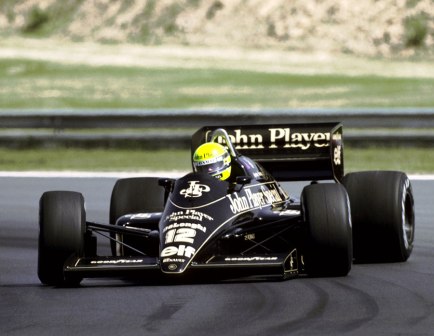
It did not take Senna long to adapt to the more competitive Lotus 97T-Renault as in Round 2 at Estoril in Portugal he took his first pole position and then when raceday dawned in torrential rain Senna showed his class to completely dominate the field and take his first win . As the season went on Senna had more success in qualifying than in the races as by the end of 1985 he had claimed 7 pole positions and through unreliability only 2 race wins both in the wet at Portugal and Belgium. He finished 4th in the drivers’ championship with 38 points however his intensity didn’t favor everyone as his teammate Elio De Angelis became increasingly frustrated by the bad treatment he received at Lotus as all their attention became focused on Senna, subsequently leaving to join the Brabham team for 1986.
The choice of his replacement became a controversial issue as the sponsors and team principal wanted Brit Derek Warwick, however Senna insisted Lotus wasn’t capable of running two fast drivers and vetoed Warwick. Lotus eventually signed another Brit in Johnny Dumfries however he never seriously challenged Senna throughout the year. 1986 was similar to 1985 as with the Lotus 98T-Renault he took 8 poles and 2 wins in Spain and Detroit to eventually finish 4th in the drivers’ standings with 55 points, but it could have been a much better season as he was leading the drivers world championship early on only for unreliability to tarnish his title hopes in 1986. Senna sliding his Lotus in 1986. http://4.bp.blogspot.com/-aUtq5bZaf80/T1OCFMlRtaI/AAAAAAAAAlc/6zhXd06CYy8/s1600/Hungary+1986+-+Senna.jpg
1987 saw big change for Lotus as their long standing relationship with Renault ended with the new Lotus 99T now being powered by Honda, starting a relationship that became very close to Senna during his F1 career. This also meant he received a new teammate in Satoru Nakajima. 1987 was a slightly more successful season for Senna in reliability as whilst he only claimed 1 pole and 2 wins, his first of many wins in Monaco, and again in Detroit alongside improved reliability meant he finished the year 3rd in the drivers title with 57 points. Senna realized Lotus couldn’t provide him with a title-winning car and it was announced in late 1987 he would join McLaren for 1988 alongside Alain Prost also with Honda power. Finally Senna has a car capable of winning the world title for 1988 with early tests showing the McLaren MP4/4-Honda to be almost 2 seconds quicker than the rest despite the car arriving late before the start of the season.
The 1988 F1 season is an illustration of a team having the almost perfect season as McLaren was totally dominant with Senna taking 13 from 16 poles and 8 wins with McLaren taking 15 from 16 wins. Many were surprised that Senna could beat Alain Prost who was seen as the best at the time. Although Prost finished the season with more points than Senna dropped scores meant the title was won by Senna by 3 points (90-87). Senna almost lost this title through greater inconsistency compared to Prost however this season was the first where Senna could be seen as the season’s benchmark driver with his highlight and low point of the season both being in Monaco. In qualifying he managed to set a time 1.5 seconds faster than Prost astounding the F1 paddock that Senna could be so much faster. He duly dominated the race and was closing in on victory when he lost concentration and crashed putting himself out and handing Prost the win thanks to a rookie mistake. Also this season saw the first break in the Senna/Prost relationship as in Portugal Prost went to overtake Senna who used what was seen as overly aggressive tactics in blocking Prost who still managed to make it through. Senna on his way to a first title in 1988. http://upload.wikimedia.org/wikipedia/commons/b/b3/Ayrton_Senna_1988_Canada_cropped.jpg
1989 saw the banning of the turbo engines which had be so effective for Honda in 1988 and some doubted if the McLaren MP4/5-Honda could maintain its superiority in 1989. Although the season was less successful for McLaren with a greater unreliability McLaren still possessed the fastest car as was shown by Senna who again took 13 from 16 poles and 6 victories. This however was a very controversial year for McLaren as the Senna/Prost relationship disintegrated to the point of not speaking to each other. The bad blood built up until it reached a peak at the title deciding Japanese GP where Senna needed to win to keep his title hopes alive. From the start Prost made a better getaway and led from Senna. Going into the later laps Senna began to close on Prost until he attempted a move on Lap 46 which ended badly with both colliding and going off the track. Prost jumped from his car whereas Senna waited for the marshals to push him back onto the track after missing one corner. Senna subsequently rejoined and won the race before being disqualified for missing part of the track leaving Prost with the title in 1989. This incensed Senna who even thought about quitting the sport during the winter of 1989/1990. Here’s a link to the infamous 1989 incident between Prost and Senna. https://www.youtube.com/watch?v=EFuZ_DuQG9A
1990 was a pivotal season for Senna who very late in the day decided to continue with F1 and McLaren. The ramifications of the previous season were that Prost moved to Ferrari to be replaced by Austrian Gerhard Berger. 1990 saw Senna again maintain his title of the fastest man in F1 with 10 poles from 16 and 6 wins teamed with a greater consistency meaning again a title showdown was set for the Japanese GP however this year if Prost failed to finish Senna would be champion. Senna duly took pole however he was incensed when it was then moved to the dirtier side of the track, which he saw as favoring Prost. Therefore at the start as predicted by Senna Prost made the better start however going into the first turn Senna lunged to the inside into a disappearing gap eventually making contact with Prost and finishing the race for both men ensuring Senna took his second world title (78 to Prost’s 71). Here’s footage of the other infamous incident between Prost and Senna in 1990. https://www.youtube.com/watch?v=SvSgJDIsRnc
Many have since questioned the motives of this move with many stating that Senna deliberately drove into Prost as revenge for the previous year which was something Senna hinted as being true a year later. Either way this has become one of the most controversial moments in F1 history alongside the actions in 1989 and many people connected with racing have diminished the legacy of Senna citing this case as an example. Also many have refused to rank Senna as a truly great driver because of the incident, which is arguably the most damaging of his career. Some were worried the 1991 season was going to carry on in a similar vain to 1989/1990 however 1991 saw a cooling of the Prost/Senna dispute with their performance being a big factor. Whilst McLaren continued to be the best team as Senna used the McLaren MP4/6-Honda to take 8 poles and 7 -wins including taking the first 4 poles and wins of the season setting a record.
Meanwhile Prost and the Ferrari underachieved failing to take a single pole or win before embarrassingly being sacked from Ferrari before the last race of the season for negative comments he made about the car. However in the German GP he was again critical of Senna and his defensive tactics before promising to help rival Nigel Mansell in the title battle after a closely fought dice on the track for position which eliminated Prost from the race.
Senna faced a new challenger in the highly sophisticated Williams-Renault and Nigel Mansell seriously challenged Senna before eventually spinning out of the Japanese GP to hand Senna his third world title by 24 points 96-72 in a much more sporting championship free from major controversy. This seemed to be the year Senna validated himself as a great becoming the then youngest ever 3-time world champion.
1992 was a unhappy year for Senna as the sophisticated Williams-Renault package which had challenged in Mansell’s hands in 1991 significantly improved leaving it clear from the rest and for the first time since Senna joined McLaren they did not have the fastest car and lagged behind Williams in the technological race rendering them uncompetitive in 1992.Senna only managed to take 1 pole but used his talent to take 3 wins including an iconic drive in the late stages of the Monaco GP as Mansell suffered problems and rejoined behind Senna with 7 laps to go. Despite the Williams being a much faster car Senna managed to successfully defend his lead to take a record equaling 5th Monaco win. Senna stoutly defending at Monaco in 1992. http://www.f1fanatic.co.uk/2011/06/04/ayrton-sennas-f1-career-pictures/1992-1-2/
Despite 3 wins his unreliability meant he only finished the season in 4th place on 50 points only 1 ahead of teammate Gerhard Berger. The only saving grace for Senna was that Prost was on a sabbatical and therefore again this season was free from major controversy. 1992 was also significant as Honda pulled out of F1 at the end of the year severely affecting Senna who had built a very close relationship with them even crying during a interview during the Japanese GP, held at a Suzuka track owned by Honda.Senna ended 1992 debating whether to take a year out from F1 in 1993 as he felt he had no chance of winning the title with the Williams being so dominant and Honda pulling out of the sport. Senna was reluctant to test the new McLaren MP4/8-Ford however when he finally did he was impressed with the new car but still only agreed to sign a race by race deal with McLaren.
Berger had rejoined Ferrari for 1993 so American Michael Andretti joined him. Again Senna only took 1 pole however he showed his considerable ability by taking 5 wins including the European GP at Donington which is widely known as one of the most masterful victories in F1 history after Senna went from 5th to take the lead on the first lap before dominating the race. He also claimed a record breaking 6th win in Monaco, a record that still stands. Senna improved to 2nd in the drivers table on 73 points however he was increasingly unhappy with the dominance of the Williams and actively tried to join them for 1993 unsuccessfully however when Prost retired he took his place at Williams for 1994 ending a tumultuous yet highly successful 6 year association with McLaren. Here’s a link to Senna’s dominant opening lap at the 1993 European GP. https://www.youtube.com/watch?v=nwLEE420v20
1994 was a season many predicted as being a dominant one for Senna and Williams but the sophisticated electronic aids helping the driver, pioneered so effectively by Williams were banned for 1994 leaving the title more wide open than many believed. The first few races highlighted this as although Senna took 2 poles he failed to finish both through errors whilst his teammate Damon Hill was not near the front with many believing Hill’s performances was a true reflection of the car and Senna was masking it’s true ability. Going into the San Marino GP a Senna victory was seen as a necessity as Senna again took pole from title leader Michael Schumacher in the Benetton-Ford. The weekend was marred by tragedy however as in Friday qualifying Senna protégé Rubens Barrichello severely crashed his Jordan-Hart and was lucky to emerge unhurt, whilst in Saturday qualifying Austrian Roland Ratzenberger in the lowly Simtek-Ford crashed heavily. Despite immediate medical attention Ratzenberger was pronounced dead soon after the accident. This was the first fatality in F1 for 8 years and many were shocked with everyone simply wanting the weekend to be over. Senna spinning off in Brazil 1994. http://3.bp.blogspot.com/_dP1-J5FboIU/ScvdYHslgKI/AAAAAAAAD_4/BhpQtnlqN0o/s400/spin_senna.jpg
The race still went ahead and from the lights Senna took the lead however a big crash behind brought out the safety car with Senna at the front. The safety car went in at the end of lap 6 and Senna was immediately on the pace trying to build a gap to Schumacher despite the car not yet at its optimum after the safety car with visible sparks showing how hard he was pushing. Indeed his lap 6 time would only be bettered later on by two other drivers despite the cars running much lighter fuel loads throughout the race.At the beginning of lap 7 Senna entered Tamburello corner however half way through the corner the car veered off the track violently with Senna slamming into the wall in a massive accident. Medical assistance was swift however early on they could see it was going to be a serious injury especially around his head. He was airlifted to a local hospital with the whole paddock anxious for information with many rumors on his condition circling.
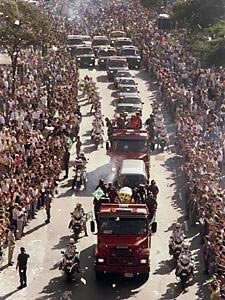
The race was restarted with Schumacher taking a hollow victory however the paddock was shocked to hear that at 6.40pm Senna was declared dead from a fatal head injury caused by the crash. Immediately the news spread round the world and in Brazil 3 days of national mourning were announced. His body was returned to Brazil on the 3rd May two days after the accident with a full military salute given before a state funeral on the 5th May in Sao Paulo with many of the racing community attending as well as millions who lined the streets to pay their respects to him. A photo from Senna’s funeral showing his public support. http://www.formula1-dictionary.net/Images/senna_funeral_1.jpg
In conclusion the social impact of Ayrton Senna is something which is hard to measure definitively. What is clear however that is during his career Brazil was experiencing many problems relating to the economy and government and whereas other sporting heroes tried to hide their Brazilian roots Senna provided hope and joy for the country as every time he won he would proudly wave the Brazilian flag. His social impact was not just emotional and throughout his career his donated tirelessly to charities with some estimates suggesting he donated up to £400 million over his career and just before his death he was planning to start a charity in Brazil helping underprivileged children and this still lives on in his honor with the Ayrton Senna Institute helping millions of children through education and a wide range of activities since 1994.
The best indicator of the social impact Ayrton Senna had on Brazil is the reaction to his death as in Brazil the country going into three days of national mourning and the fact millions lined the streets to pay their respects at his funeral. His lasting impression on Brazil is another significant sign of his social impact as on May 1st every year Senna is remembered throughout Brazil and worldwide both inside and outside the racing community showing that Senna was more than just a racing driver to many and his social impact spreads well beyond motorsport.
For anyone interested in Motorsport I have set up a website dedicated to Motorsport reports. My latest post about the F1 United States GP from Austin, Texas can be viewed with this link http://www.motorsportsreports.co.uk/f1usarace.html
For more motorsports reports feel free to check out my website dedicated to motorsport reports . My link to the 2013 United States GP Qualifying report is here http://www.motorsportsreports.co.uk/usaquali.html
For all racing drivers starting out in racing the ultimate dream is to reach Formula 1. This dream for many drivers is turning into the impossible dream with the direction F1 has taken in the last decade. The cost saving measure of severely limiting testing, has made it almost impossible now for many young drivers to gain any experience of an F1 car outside of a race weekend. A perfect example of this is the imminent announcement of Lotus, that Heikki Kovalainen will replace Kimi Raikkonen for the final two races of the 2013 season.
On the surface this appears to be a fairly innocuous appointment in the grand scheme of F1 because it’s only for two races. Yet this could have a major effect on the future of F1, and all because of a driver Lotus already has under contract. Enter into the fray young Italian Davide Valsecchi. He’s a very quick driver who after a close fought battle claimed the 2012 GP2 title and despite 2012 being his fifth year in the category he was hopeful of stepping up to Formula One in 2013. Despite already having some experience in F1 as a reserve driver for the now Caterham team in 2011 to match his GP2 title he found offers in F1 hard to come by, and eventually took a reserve driver deal with Lotus for 2013. With little running during the year it appeared his chance had come when Raikkonen announced his decision to undergo back surgery and therefore miss the final two races.
On the other hand the team had different ideas and it appears instead offered the drive to half the F1 paddock as they sounded out Nico Hulkneberg and even Michael Schumacher before giving the drive to Heikki Kovalainen. This is a perfect example of the increasing struggle of many young drivers hoping to reach F1 as many teams are sticking with proven, experienced drivers rather than taking a chance on a young prospect. Indeed the only way to get into F1 for a young driver in the current climate appears to be waving millions of pounds worth of sponsorship at teams with rookies Esteban Gutierrez, Max Chilton and Geido Van Der Garde taking the route into F1 for 2013. All of these drivers incidentally, finished behind Valsecchi in GP2 in 2012. On the other hand, there are some teams on the grid willing to give young drivers a chance with Force India exemplifying this the most with the third driver/free practice role they have given to Paul Di Resta in 2010, Nico Hulkenberg in 2011, Jules Bianchi in 2012 and now James Calado in 2013.
All of these drivers save from Calado have progressed to race drives with Williams also nurturing Valterri Bottas with free practice drives throughout the 2012 season to prepare him for a race drive in 2013. Indeed, free practices at F1 weekend are turning into extended test sessions for many teams looking to try out a new young charger they hope will be a future world champion.
Finally in reflection, this week has shown both sides of the young driver coin as despite the fact most of the headlines have been made by Davide Valsecchi being overlooked by Lotus in favour of Heikki Kovalained, it has also emerged this week that McLaren appear poised to give one of their young drivers in Kevin Magnussen a race drive with the team in 2014 replacing Sergio Perez therefore showing that for many drivers the choice of team in any F1 role can make or break your career. Nothing near there then.


 sportsjournalismsgs